AI Adoption: Strategies for Mid-Market Success
July 25, 2024

Artificial intelligence (AI) is revolutionizing industries, and mid-market businesses can’t afford to be left behind. Discover how Escalate Group leverages the Microsoft AI Strategy Roadmap to help CEOs navigate AI adoption, enhance operational efficiency, and drive innovation for exponential growth.
Challenges Mid-Market Organizations Face in AI Adoption:
Adopting AI can revolutionize mid-market organizations, but several challenges often stand in the way. The complexity and variety of AI technologies can be overwhelming, making it difficult to prioritize and start AI projects effectively. Many organizations struggle to find a clear starting point, leading to inefficiencies and misaligned efforts.
Leadership often overestimates their organization’s AI readiness, resulting in unrealistic expectations and potential failures. Initial assessments tend to be overly optimistic, with deeper evaluations revealing significant gaps. Without a clear commitment from top leadership, AI projects may lack the necessary support and resources, hindering progress.
Cultural and organizational barriers also pose significant challenges. Resistance to change and a lack of AI expertise can impede adoption and slow down implementation, affecting the quality of AI solutions. Accessing complete and relevant data is crucial for training and deploying AI models, yet many organizations struggle with this. Transitioning to cloud infrastructure from on-premises setups can be challenging, particularly for those in the early stages of AI readiness.
Governance and ethical concerns cannot be overlooked. Many organizations lack adequate processes, controls, and accountability structures for AI. Ensuring data privacy, security, and regulatory compliance is a critical concern that many are not fully prepared to address.
Demonstrating the value of AI can be difficult, especially in the early stages. Proving ROI and shifting focus from operational efficiency to growth-oriented use cases requires strategic planning and a mature understanding of AI’s potential. Scaling AI solutions from pilot projects to full-scale deployment requires robust processes, sufficient resources, and a strategic approach. Maintaining consistent value from AI initiatives as they scale presents ongoing challenges.
Organizations must customize their AI strategies to address unique needs and industry contexts, ensuring effectiveness and relevance.
High-Level Lessons from Microsoft AI Strategy Roadmap:
The Microsoft AI Strategy Roadmap emphasizes that successful AI adoption is a holistic process involving strategic alignment, technological readiness, leadership support, cultural adaptation, and robust governance. By understanding and addressing these multifaceted aspects, organizations can effectively navigate their AI journey and achieve sustainable value.
1. AI Readiness is Multi-faceted:
Successful AI adoption requires more than just technological capabilities. It involves strategic alignment, robust data infrastructure, strong leadership, cultural readiness, and comprehensive governance.
2. Five Key Drivers of AI Success:
Business Strategy: AI initiatives must align with overall business goals to ensure relevance and impact.
Technology and Data Strategy: Quality data and scalable infrastructure are foundational to AI success.
AI Strategy and Experience: Organizations need expertise and repeatable processes to implement AI effectively.
Organization and Culture: Leadership vision and a supportive culture are critical for AI adoption.
AI Governance: Robust governance frameworks are essential to manage risks and ensure responsible AI use.
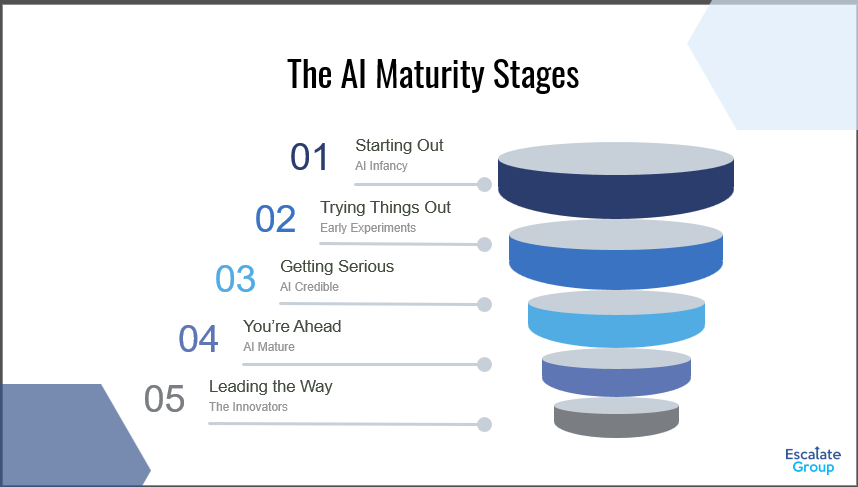
Organizations typically progress through stages: Exploring, Planning, Implementing, Scaling, and Realizing. Each stage has unique priorities and challenges that need tailored strategies. There is no one-size-fits-all approach to AI. Strategies must be customized based on the organization’s specific needs, industry context, and current stage of AI readiness.
Leadership, high-quality data access, and robust infrastructure are critical for AI scalability and success. Building a culture that supports innovation, agility, and continuous learning is essential for AI adoption. Engaging and upskilling employees is a key part of this process.
Initial AI efforts often focus on operational efficiency and cost savings. As organizations mature, the focus shifts to growth-oriented objectives such as innovation and revenue generation. Establishing comprehensive AI governance to address data privacy, security, and ethical issues is fundamental to building trust and ensuring compliance. Organizations need to continuously monitor and evaluate their AI initiatives, adapting strategies as needed to maximize value and address emerging challenges.
Essential ExO Attributes for AI-Driven Organizations:
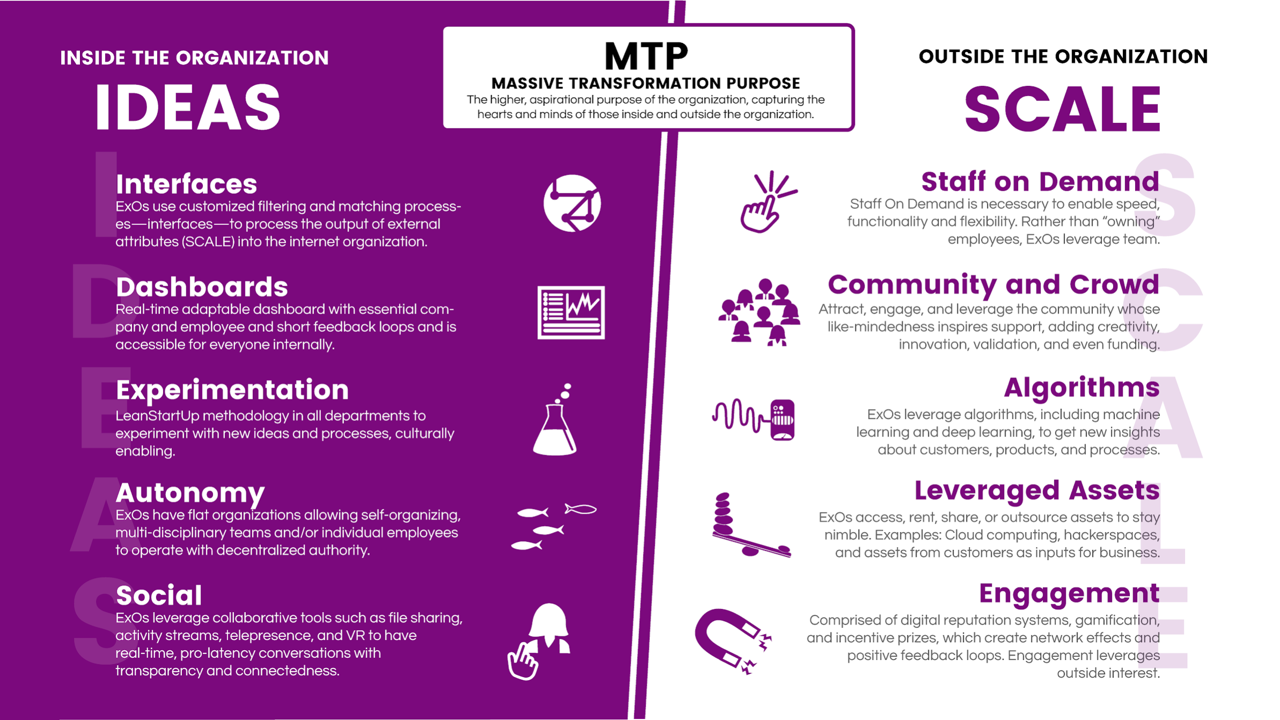
Prioritizing key attributes for an Exponential Organization (ExO) adopting and implementing AI initiatives effectively can be crucial for maximizing impact and achieving exponential growth. Here’s a prioritized list based on our experience with AI transformation:

Integrating ExO Attributes into AI Strategic Roadmap
1. Massive Transformative Purpose (MTP):
Establishing a clear and compelling MTP aligns the organization’s vision with its AI initiatives. For example, a global distributor of commodities might adopt an MTP of “Transforming Global Supply Chains for Sustainability,” guiding all AI efforts towards enhancing efficiency while promoting eco-friendly practices.
2. Algorithms:
Integrating AI algorithms is essential for operational efficiency and decision-making. These algorithms enable real-time data analysis and predictive capabilities. For instance, a logistics company could implement routing algorithms that optimize delivery paths based on traffic data, significantly reducing costs and improving service times.
3. Data-Driven Customer Analytics (Algorithms):
Utilizing data-driven customer analytics to personalize marketing efforts enhances customer engagement and loyalty. A retail ExO could analyze purchasing patterns to tailor promotions, leading to increased sales and customer satisfaction.
4. Experimentation:
Fostering a culture of experimentation is vital for innovation. By encouraging teams to pilot AI initiatives, organizations can discover effective applications and refine their approaches.
5. Community & Crowd:
Engaging with a community of users and stakeholders drives co-creation and innovation. An ExO might establish platforms for customers to provide feedback on AI-driven solutions, allowing for continuous improvement and adaptation.
6. Staff on Demand:
Leveraging external talent provides flexibility and access to specialized skills. For instance, a company could hire freelance AI experts to develop machine learning models, staying at the forefront of technological advancements without the long-term commitment of full-time hires.
7. Engagement:
Creating engaging experiences through AI-driven interactions enhances customer satisfaction and loyalty. A financial services ExO could implement chatbots powered by large language models to provide personalized customer support, improving response times and user experience.
8. Dashboards:
Implementing real-time dashboards to monitor KPIs related to AI initiatives helps organizations make informed decisions. For example, a manufacturing ExO could track metrics such as production efficiency and downtime in real-time, enabling quick adjustments to operations.
Integrating ExO Attributes into AI Strategic Framework:
Exponential Organization (ExO) that effectively adopts and implements AI initiatives is defined as a forward-thinking entity that harnesses advanced AI technologies—including AI algorithms, machine learning models, large language models, and generative AI—to drive transformative growth and innovation at an unprecedented scale, leveraging low-code platforms and other cloud-based business solutions that already integrate the complexity of the technology for every one adoption. This organization integrates these AI capabilities into its core operations, enabling data-driven decision-making, enhancing customer experiences, and optimizing processes to achieve ten times greater outcomes than traditional organizations.
By integrating ExO principles into the AI strategic framework, organizations can enhance their capacity for rapid innovation, operational efficiency, and significant value creation, ultimately achieving exponential growth.
1. AI Readiness and Strategy:
Embed the MTP into the AI vision and strategy. Develop a roadmap that incorporates ExO principles, emphasizing flexibility, community engagement, and continuous learning.
2. Technology and Data Strategy:
Leverage cloud computing, low-code platforms, AI-as-a-Service, and scalable infrastructure. Ensure data quality and accessibility to support data-driven decision-making and continuous improvement.
3. Organization and Culture:
Foster a culture of experimentation and autonomy. Engage employees through gamification and user-centric design. Promote transparent communication and community involvement.
4. AI Governance:
Implement robust governance frameworks to manage risks, ensure compliance, and maintain trust. Use real-time dashboards to monitor and report on AI governance metrics.
An Exponential Organization effectively adopting AI initiatives enhances its internal capabilities through cutting-edge technologies and redefines its market approach by delivering innovative solutions that meet evolving consumer needs, ultimately achieving exponential growth and impact in a competitive landscape.
Conclusion:
Successfully navigating AI adoption requires a strategic, multi-faceted approach that integrates technology, culture, governance, and leadership. Mid-market organizations can unlock significant value by aligning AI initiatives with business goals, fostering a culture of innovation, and implementing robust governance frameworks. As you embark on your AI journey, remember that customization and adaptability are key. Embrace the principles of Exponential Organizations to stay ahead of the curve and achieve transformative growth. At Escalate Group, we are here to guide you through every step, ensuring your AI initiatives drive meaningful impact and sustainable success.