Choosing the Right AI Model: A Mid-Market Framework

Choosing the Right AI Model: A Mid-Market Framework

May 26, 2026

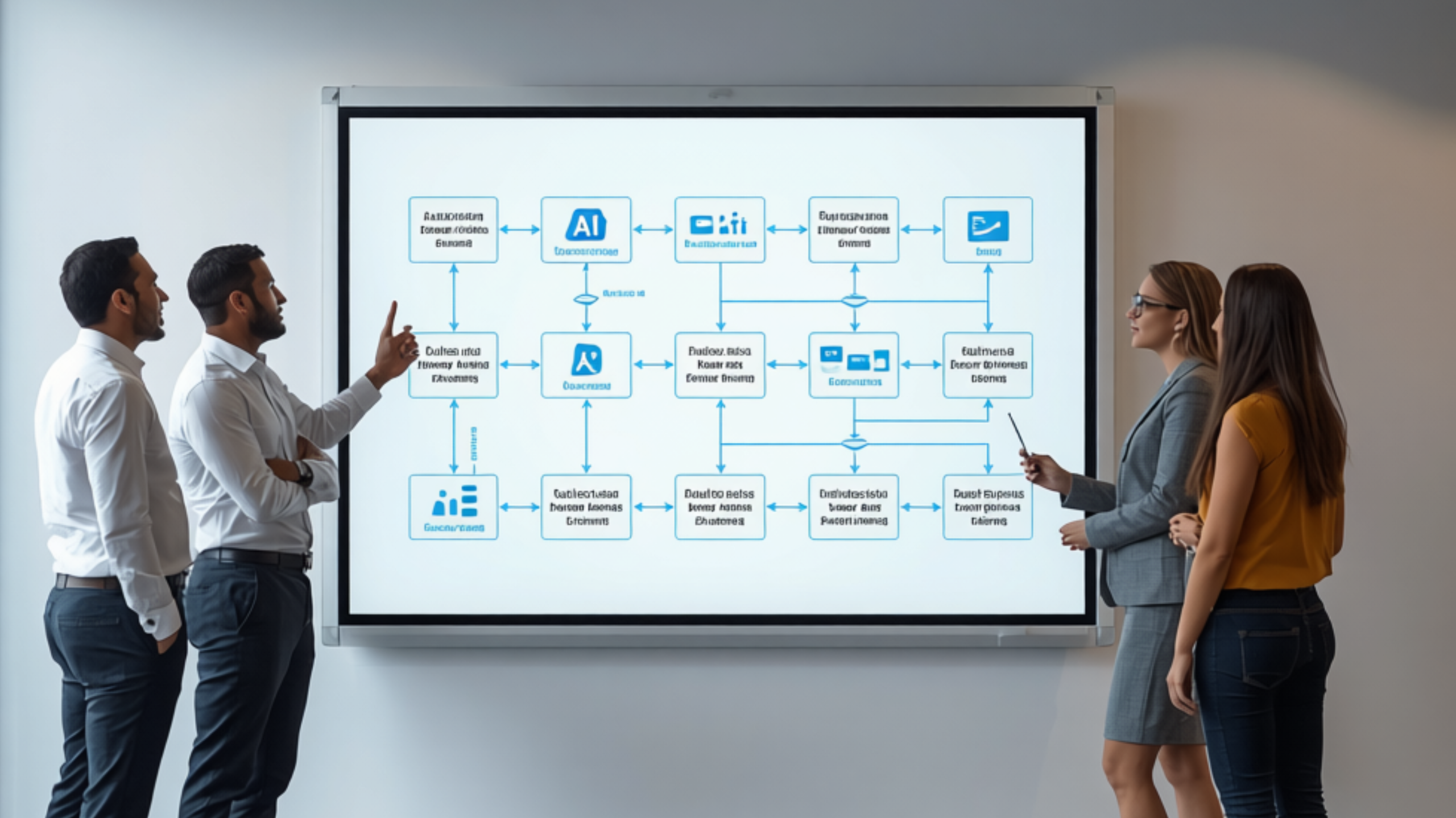
Mid-market leadership team evaluating AI model options on a whiteboard

Learn how mid-market leaders can choose the right AI model by evaluating business value, workflow fit, data access, governance, and total cost, not hype or benchmarks.

Introduction

Every week brings a new AI model release, a new benchmark result, and a new claim that one provider has “won.”

For CEOs, CIOs, and mid-market leadership teams, this creates a practical problem: how do you choose the right AI model without slowing execution, increasing risk, or betting too early on the wrong platform?

The answer rarely starts with the model. It starts with the use case.

Organizations stuck in AI pilots are usually not there because they picked the wrong model. More often, they are stuck because they never built a clear way to evaluate AI decisions against business outcomes, workflow realities, governance requirements, and cost. We see this pattern often in our own engagements, and it tends to trace back to the same root cause.

That is a validation gap, not a technology gap, and it is a pattern we have written about before in Why AI Pilots Fail and How Mid-Market Leaders Make Them Stick.

This article offers a practical framework for choosing the right AI model for your business, without relying only on hype, vendor claims, or benchmark rankings.

What is covered in this article

  • Why “which AI model is best” is the wrong starting question.
  • How frontier models fit into a mid-market decision, and why that matters.
  • Why model selection should start with the business outcome, not a feature comparison.
  • A four-part framework for evaluating any model: business outcome, operational, governance, and economic fit.
  • A practical example comparing two common use cases.
  • Why data location and workflow fit often matter more than benchmark scores.
  • Why platform-agnostic thinking still matters.
  • A ten-question checklist that leadership teams can use before deciding.

What Is the Best AI Model for a Business?

The best AI model is not always the most powerful model.

It is the model that best supports the business use case, integrates with existing workflows, respects data and governance requirements, fits the organization’s cost structure, and can adapt as the market changes.

This is also where frontier models enter the conversation. A frontier model is one of the most advanced AI models available at a given time, typically capable of complex reasoning, long-context understanding, and a broad range of tasks without extensive customization. Frontier capability sets the practical ceiling on what is possible right now: the use cases worth pursuing, the level of automation realistically achievable, and the pace at which competitors can move. Knowing what a frontier model is matters less for picking the newest release and more for understanding the realistic boundaries of what any model, frontier or otherwise, can do for your business today.

For one company, the right choice may be a model embedded inside an existing productivity suite.

For another, it may be a specialized model connected to a specific process, dataset, or customer-facing application.

For another, it may be a multi-model approach where different models serve different business functions.

The better question is not: Which AI model is best?

The better question is: Which AI model is best for this use case, under these constraints, at this cost, with this level of risk?

That shift changes the decision.

Why “Which AI Model Is Best?” Is the Wrong Starting Question

The search for a universal winner assumes AI models can be evaluated independently of context. In practice, context is everything.

Organizations do not invest in AI because they want access to a model. They invest in AI to achieve better decisions, improved productivity, stronger customer experiences, lower operating costs, faster execution, and new paths to growth.

Once the conversation returns to those objectives, model rankings become less important.

A high-performing model may still be the wrong choice if it cannot access the right data, fit into existing workflows, meet governance requirements, or justify its total cost.

The model that performs best on a public benchmark is not always the one that creates the most value in your business.

That is why model selection should begin with business fit, not technical comparison.

Start With the Business Outcome

Before comparing models, leadership teams should agree on the business outcome they are trying to improve.

This does not need to become a long strategy exercise. But it does need to be clear.

For example:

  • Are you trying to reduce customer service response time?
  • Improve sales team productivity?
  • Accelerate document review?
  • Automate internal reporting?
  • Improve forecasting?
  • Support compliance-heavy workflows?
  • Create better access to organizational knowledge?

Each outcome changes the evaluation criteria.

A customer service use case may require CRM integration, escalation workflows, quality monitoring, and customer data protection.

An internal knowledge assistant may require secure access to document repositories and collaboration tools while respecting employee permissions.

A finance or healthcare use case may require stronger controls around data handling, retention, auditability, and human review.

The right AI model depends on the work it needs to support.

A Four-Part AI Model Selection Framework

Rather than comparing models by name, evaluate each option against four practical categories.

1. Business Outcome Fit

Start with the business result.

Ask:

  • What process are we trying to improve?
  • What measurable outcome will define success?
  • Who will use the AI solution?
  • What decision, task, or workflow should become faster, better, or less costly?
  • What KPI will show that the model is creating value?

This step keeps the conversation grounded.

Without a clear outcome, model selection becomes a matter of preference. One executive may prefer a familiar vendor. Another may prefer the newest model. Another may focus only on cost. Business outcome fit gives the team a shared starting point.

The goal is not to choose the most impressive model. The goal is to choose the model that can support a measurable business improvement.

2. Operational and Integration Fit

AI creates value when it becomes part of how work gets done.

A model that requires people to leave their standard tools, copy information into a separate interface, or build workarounds may struggle to gain adoption.

Ask:

  • Will this model work inside the tools employees already use?
  • Can it connect to the systems that matter?
  • Does it support the workflow from start to finish?
  • Will users need significant retraining?
  • Does it create a parallel process or improve the current one?
  • Can business and IT teams support it over time?

This is where many AI initiatives slow down.

A model may be technically strong but operationally difficult. It may perform well in a demo but require too much effort to embed into daily work.

For mid-market organizations, that friction matters.

Teams are often balancing limited time, lean IT resources, security requirements, and pressure to show measurable progress. The right model should reduce complexity, not add another disconnected tool to the stack.

3. Governance and Risk Fit

Governance should narrow the field before performance benchmarks enter the conversation.

Ask:

  • What data will the model need to access?
  • Where does that data go?
  • Who can access it?
  • How is it stored or retained?
  • Can the organization monitor usage?
  • Does the solution respect existing permissions?
  • Are human review steps required?
  • What risks would be unacceptable for this use case?

This is especially important in regulated or sensitive environments such as Financial Services, Healthcare, Manufacturing, and other sectors where data stewardship, compliance, or operational risk is a leadership concern.

Governance does not mean slowing everything down. It means making sure the model is appropriate for the work it will perform.

For a low-risk internal productivity use case, the governance requirements may be lighter. For a customer-facing or compliance-sensitive workflow, the requirements should be much stronger. The key is to match governance to the use case.

For a vendor-neutral reference point, the NIST AI Risk Management Framework is a useful starting point for thinking about responsible AI adoption across any model or provider. For a more operational view, see our related article on AI Governance for Mid-Market Companies in 2026.

4. Economic Fit

Model pricing is easy to compare. Total cost is not. Per-token pricing, subscription cost, or license fees are only part of the picture.

Ask:

  • What will integration cost?
  • What internal resources are required?
  • Will employees need training?
  • How much prompt engineering or configuration is needed?
  • What governance, monitoring, or security work is required?
  • What happens if the organization needs to switch models later?
  • How much rework will be required as use cases evolve?

A cheaper model can become expensive if it requires constant manual work, custom integration, or repeated reconfiguration.

A more expensive model may be easier to justify if it works reliably, integrates well, reduces adoption friction, and supports measurable business outcomes.

The real question is not: Which model is cheapest?

The better question is: Which model delivers the best value after accounting for integration, adoption, governance, and switching costs?

A Practical Example: Customer Service vs. Internal Knowledge

Consider two common AI use cases.

For a customer service use case, the right model may need to connect to CRM data, understand customer history, support escalation workflows, follow approved response guidelines, and allow quality monitoring.

In that case, workflow fit, customer data protection, and response reliability may matter more than raw model performance.

For an internal knowledge assistant, the right model may need to securely connect to company documents, respect access permissions, and work inside the tools employees already use every day.

In that case, data location, permission handling, and search quality may matter more than choosing the newest model on the market.

Both use cases involve AI. But they do not require the same evaluation.

That is why model selection should always start with the job the model needs to perform.

Why Data Location and Workflow Fit Matter More Than Most Leaders Realize

For many organizations, the most important variable in model selection is not the model itself. It is where information lives. AI becomes more useful when it can securely access the knowledge, documents, systems, and context employees need to do their work. That makes data location a practical decision factor.

Ask:

  • Is the data in a productivity suite, a CRM, an ERP system, a data warehouse, or several disconnected systems?
  • Does the AI solution respect current permissions?
  • Can it access the right information without exposing sensitive data?
  • Does it support the organization’s governance requirements?
  • Does it fit into daily work, or does it require people to change how they operate?

This is often where the difference between a promising pilot and a scalable solution appears.

A model that looks strong in a controlled test may create limited value if employees cannot use it naturally inside their workflow.

A good-enough model that is secure, integrated, and easy to adopt may create more value than a more advanced model that sits outside how the organization works.

Why Platform-Agnostic AI Still Matters

Recognizing the importance of workflow fit does not mean becoming locked into one platform forever.

Platform-agnostic does not mean platform-blind.

It means understanding the advantages of your current ecosystem while preserving the flexibility to adapt as models, costs, and business needs evolve.

For example, an organization already invested in Microsoft technologies may find strong value in AI tools that integrate with Microsoft 365, Azure, Power Platform, or Copilot Studio. That existing ecosystem can reduce friction and accelerate adoption.

But that does not mean every use case should automatically default to one model or provider. Some use cases may require specialized models, different deployment options, or different cost structures. The goal is not to remain undecided.

The goal is to make decisions that are practical today and flexible enough for tomorrow.

AI models will continue to evolve. Providers will change. Costs will shift. Capabilities will improve.

A strong evaluation framework helps leadership teams make decisions now without locking the organization into choices that become difficult to change later.

For leaders seeking broader principles for trustworthy AI adoption beyond any single vendor, the OECD AI Principles offer an accessible, executive-level reference.

AI Model Selection Checklist

Before selecting an AI model, leadership teams should be able to answer the following questions:

  1. What business outcome are we trying to improve?
  2. Which workflow will this model support?
  3. Who will use it?
  4. What data does it need to access?
  5. Where is that data stored?
  6. Does the solution respect current permissions?
  7. What governance or compliance requirements apply?
  8. How will success be measured?
  9. What is the total cost beyond model pricing?
  10. How difficult would it be to change models later?

If these questions are difficult to answer, the organization may not need another model comparison yet. It may need a clearer use case, better success criteria, or a more practical evaluation process.

How Often Should Organizations Revisit AI Model Decisions?

AI model decisions should be reviewed periodically, but not reactively.

Revisiting the decision every time a new model is released creates confusion and slows execution. A better approach is to set a regular review cadence based on business need.

For example:

  • Review key model decisions every six months.
  • Reassess sooner if the use case changes materially.
  • Reassess if costs shift significantly.
  • Reassess if governance requirements change.
  • Reassess if a new capability creates a clear business advantage.

This keeps the organization flexible without turning every market announcement into a strategy reset.

The point of a framework is not to make one perfect decision. It is to make better decisions repeatedly as the market changes.

Conclusion: The Right Model Starts with the Right Criteria

The organizations that create the most value from AI will not necessarily be the ones that predicted every technology winner.

They will be the ones who learned how to evaluate AI options clearly, apply them to the right use cases, manage risk, integrate them into real workflows, and measure business impact. If your leadership team is stuck debating which AI model to standardize on, that debate may be a symptom of a missing decision framework.

The answer is not more research into every vendor roadmap. The answer is a practical way to evaluate models against your actual use cases, data environment, workflow needs, governance requirements, and total cost.

Organizations rarely need another model comparison. They need clarity on where AI can create measurable value, how success will be measured, and which model or platform best fits the work to be done.

That is how companies move from AI experimentation to execution.

If your leadership team is debating which AI model or platform to standardize on, a shared decision-making framework may be a better starting point. We help organizations clarify where AI can create measurable value, define practical selection criteria, and turn scattered experimentation into a focused AI roadmap.

Book a conversation with our team to talk through where your organization stands.

Frequently Asked Questions

What is a frontier model, and why does it matter for my business?

A frontier model is one of the most advanced AI models available at a given time, typically capable of complex reasoning, long-context understanding, and a broad range of tasks without extensive customization. Frontier models matter for mid-market businesses because they set the practical ceiling on what AI can realistically do right now: the use cases worth pursuing, the level of automation achievable, and the pace at which competitors can move. Understanding frontier capability is not about chasing the newest release. It is about knowing what is possible so the business can choose where to apply it.

Is the most powerful AI model always the best choice?

No. The most powerful model may not be the best fit if it creates integration challenges, governance concerns, adoption friction, or unnecessary cost. A model that works securely inside existing workflows may create more value than a technically stronger model that is harder to use.

Why does workflow integration matter when choosing an AI model?

Workflow integration matters because AI creates value when people can use it naturally in their daily work. If a model requires employees to switch between systems, manually copy data, or change established processes, adoption may suffer. Integration often determines whether AI moves beyond a pilot.

Should a company use one AI model or multiple models?

Using multiple AI models is not inherently risky. Many organizations may use different models for different use cases. The risk comes from doing this without clear criteria, governance, or ownership. A documented decision framework makes multi-model use more manageable.

How often should organizations revisit AI model decisions?

Organizations should revisit AI model decisions periodically and strategically. A six-month review cadence can work for many use cases, with earlier reviews when requirements, costs, risks, or capabilities change materially. The goal is to stay flexible without reacting to every new model release.

5 AI Priorities for Mid-Market CEOs in 2026

5 AI Priorities for Mid-Market CEOs in 2026

January 20, 2026

Lessons for CEOs 2025

5 concrete AI priorities mid-market CEOs need to set in 2026, covering organizational capability, data infrastructure, agentic AI readiness, governance, and leadership fluency. No hype. No jargon. Practitioner advice grounded in what we observed working directly with leadership teams.

Introduction:  

2025 was a turning point. Across mid-market industries, a first wave of companies transformed AI ambition into operational reality. The organizations that leaned in early are now compounding those gains.

At Escalate Group, we work directly with mid-market leadership teams on AI strategy and implementation. The pattern we observed at the end of last year was consistent. Some companies crossed a threshold. They moved from scattered pilots to real operational capability. Others stayed stuck, still waiting for clarity that never arrived.

The gap between those two groups is not about technology. It is about leadership decisions. The CEOs who made progress in 2025 made specific, deliberate choices about where to focus. The ones who did not remained open to everything and committed to nothing.

That distinction shapes everything we are advising in 2026. What follows are the five AI priorities that mid-market CEOs need to set now, not at the end of the year when the strategic window has already passed.

What is covered in this article

Five AI priorities to keep in mind for 2026:


  • Priority 1: Shifting from AI projects to a durable organizational capability
  • Priority 2: Building the data foundation before scaling AI tools
  • Priority 3: Preparing the organization for agentic AI deployment
  • Priority 4: Establishing a practical AI governance framework
  • Priority 5: Investing in AI fluency across the leadership team
  • A conclusion on what separates the leaders from the laggards in 2026
  • FAQ: Common questions mid-market CEOs are asking right now

Priority 1: Shift from AI Projects to AI Capability

The first priority for 2026 is also the hardest conceptual shift. Most mid-market organizations still think about artificial intelligence as a series of projects. A chatbot here. An automation there. A pilot with a vendor. That framing produces fragmented results.

The companies making sustained progress treat AI as an organizational capability, something that compounds over time, that requires investment in people and process, not just tools. That means building internal fluency. It means assigning ownership. It means measuring AI capability the same way you would measure any other core function. According to McKinsey’s State of AI 2025, AI high performers are three times more likely to have senior leaders actively driving AI adoption, and those leaders treat it as a strategic initiative, not a technology project

In our work with mid-market organizations, the ones that made the leap to production in 2025 had one thing in common. They had a senior leader, not a vendor, not a consultant, accountable for AI outcomes. Not accountable for the technology. Accountable for the business results.

For 2026, every mid-market CEO should be able to answer a simple question: who in my organization owns AI capability, and what are they measured on? If the answer is unclear, that is where to start.

Priority 2: Build the Data Foundation Before Scaling AI

Artificial intelligence is only as good as the data it runs on. That is not a new idea. But the urgency behind it is new.

As AI tools become more capable, particularly agentic systems that take sequences of actions with minimal human oversight the quality of your data becomes a direct constraint on how far you can go. Incomplete data slows everything. Siloed data creates blind spots. Poor data governance creates liability.

Most mid-market companies have not yet resolved their data infrastructure issues. They have partially updated CRMs. ERPs that do not talk to each other. Years of customer records spread across systems that were never designed to work together. That is survivable in a world where humans synthesize information manually. It becomes a hard ceiling in a world where AI systems are making decisions at speed.

The work of 2026 is not glamorous. It is auditing what data you have, where it lives, and whether it can be trusted. It is establishing ownership and governance before the pressure of scale makes it impossible to fix. Mid-market companies that treat data infrastructure as a 2026 priority will have a material advantage by 2027.

Our post on understanding your AI journey covers the diagnostic questions worth asking before scaling. It is a useful starting point for leadership teams running this audit.

Priority 3: Prepare the Organization for Agentic AI

2025 was the year agentic AI moved from concept to early deployment. AI agents, systems that plan and execute multi-step tasks with limited human direction, are no longer theoretical. Enterprise vendors, including Salesforce, Microsoft, and ServiceNow, shipped agentic products. Mid-market companies that engaged with them early came away with a clear-eyed view of what works and what does not.

2026 is the year mid-market organizations need to prepare for broader agentic deployment, even if they are not deploying yet. That preparation has two dimensions.

The first is process clarity. Agents need well-defined processes to operate within. Ambiguous workflows, unwritten rules, and decisions made by institutional memory do not translate into agentic systems. Before you can automate a process with an agent, you must be able to describe that process precisely. Most organizations discover in this exercise that their processes are far less documented than they believed. That preparation has two dimensions. A joint study from MIT Sloan Management Review and BCG on the agentic enterprise found that the organizations gaining advantage are focused less on the technology itself and more on the human systems and governance that surround it,  precisely the readiness work most mid-market companies have yet to begin.

The second is governance. Agentic systems act. They send emails, update records, and trigger transactions. That requires clear rules on what agents are authorized to do, how decisions are escalated, and how errors are caught. Organizations that build this governance framework in 2026 will be positioned to move quickly when the tools mature. Organizations that skip it will face the same governance crisis that derailed early RPA programs.

For now, the CEO’s priority is to put agentic readiness on the leadership agenda, not as a future topic, but as a 2026 operational question. We’ll be exploring the agentic AI maturity curve in more depth over the coming months, starting with where most mid-market companies stand today.

Priority 4: Establish a Practical AI Governance Framework

AI governance is one of those topics that sounds like a compliance burden until you have had a problem. Then it becomes obvious that governance was the entire point.

For mid-market companies, AI governance does not need to be a hundred-page policy document. It needs to answer a small number of critical questions. Which AI tools are we using, and which ones are approved for business use? What data can those tools access? Who reviews AI outputs before they affect customers or employees? How do we handle errors?

The absence of answers to those questions is not a neutral position. It is a governance gap that grows more consequential as AI use expands. Employees are already using AI tools, approved or not. Data is already moving through systems with or without policy. The choice is not between having governance and not having it. The choice is between intentional governance and accidental governance.

In 2026, mid-market CEOs should task their leadership team with producing a practical AI governance framework, light enough to be actionable, clear enough to guide decisions. The goal is not to restrict AI use. The goal is to channel it.

Measurement matters here, too. Governance frameworks without metrics become shelfware. The organizations making real progress are tying AI governance to performance accountability, tracking adoption, error rates, and business outcomes on the same operational cadence they use for any other function.

Priority 5: Invest in AI Fluency Across the Leadership Team

The fifth priority is the one most often deferred, and the deferral is almost always a mistake.

AI fluency at the leadership level is not about CEOs writing code or CTOs becoming data scientists. It is about senior leaders having enough working knowledge of AI to ask the right questions, evaluate the right proposals, and hold the right conversations with their teams and their boards.

The real challenge is not a lack of interest. Most mid-market leaders are interested. The challenge is that AI education tends to be either too technical,  built for practitioners, or too superficial, built for audiences who need to sound informed at a conference. Neither serves a CEO trying to make real decisions.

At Escalate Group, we have seen organizations close this gap by doing something simple: running a structured series of working sessions with leadership teams, grounded in the company’s own context and strategic questions. Not abstract AI education. Applied AI strategy. What does this mean for our competitive position? Where are our highest-value opportunities? What do our customers actually need from this?

Those conversations are only possible when leaders have enough fluency to engage substantively. Building that fluency is a 2026 investment that will pay returns for years. Our post on how mid-market CEOs can win the AI revolution offers a useful frame for that conversation.

Conclusion: The Priority Behind the Priorities

Five priorities are still a list. And lists create the illusion of structure without forcing the harder choice: where does this sit on the actual agenda?

The mid-market CEOs who will look back on 2026 as a decisive year will be those who treated AI capabilities as a leadership responsibility rather than a technology project. That means putting it on the board agenda. It means holding the leadership team accountable for progress. It means making the organizational investments in data, in governance, in fluency that turn AI from a pilot into a competitive advantage.

The companies that move in 2026 will not just be ahead of their competitors. They will be building a compounding advantage that becomes harder to close out each quarter.

That question of whether AI is a technology project or an organizational capability will shape how mid-market companies compete for the rest of this decade. 

Frequently Asked Questions

What are the most important AI priorities for mid-market CEOs in 2026?

The five priorities that matter most in 2026 are: building AI as an organizational capability rather than running ad hoc projects; establishing a clean data foundation before scaling tools; preparing processes and governance for agentic AI; creating a practical AI governance framework; and investing in AI fluency across the leadership team.

How is agentic AI different from the AI tools mid-market companies already use?

Most AI tools in use today assist a human; they generate text, summarize documents, and answer questions. Agentic AI goes further. An AI agent plans and executes a sequence of tasks with minimal human direction. It can search the web, draft and send a communication, update a record, and trigger a next step,  all in one workflow. That capability requires a different level of process clarity and governance than AI tools that assist humans.

Why do so many AI pilots fail to reach production?

The most common reason is that pilots are designed to prove the technology works, not to prove the business case. A pilot that succeeds in a controlled setting often fails to scale because the underlying data is not clean enough, the workflow is not well-documented, or there is no one accountable for the outcome. The path from pilot to production requires organizational readiness, not just technical capability.

What does a practical AI governance framework look like for a mid-market company?

It does not need to be complicated. A practical framework answers four questions: which AI tools are approved for business use; what data those tools can access; who reviews AI outputs before they affect customers or employees; and how errors are escalated and resolved. The goal is intentional governance, not restriction. A one-page policy with clear ownership is far more effective than a detailed document no one reads.

What is the single most important thing a mid-market CEO can do on AI right now?

Assign accountability. Not to IT. Not to a vendor. To a senior leader who will be measured on business outcomes,  not on how many tools are deployed or how many pilots are running. Every other priority flows from having the right ownership in place. The organizations that made real progress in AI in 2025 all started there.

AI and Web3 Lessons for CEOs from 2025

AI and Web3 Lessons for CEOs from 2025

December 15, 2025

Lessons for CEOs 2025

These AI and Web3 lessons for CEOs from 2025 highlight how leadership teams must rethink strategy, data infrastructure, and operational processes as artificial intelligence becomes embedded in everyday business operations.

Introduction:  

By the end of 2025, one thing had become clear. Artificial intelligence had moved from a strategic conversation into an operational reality.

For mid-market company CEOs, the question was no longer whether to adopt artificial intelligence. The real question was whether it was being deployed in ways that could sustain real business operations.

Some companies made that transition successfully. Many did not.

Over the course of the year, the gap between those two groups widened.

At Escalate Group, we spent much of 2025 advising leadership teams navigating this shift. Through AI strategy work, transformation sprints, and operational deployments, we observed a consistent pattern. The companies succeeding with artificial intelligence were rarely the ones with the largest budgets or the most sophisticated tools.

They were the organizations that treated artificial intelligence as an organizational capability rather than a technology project.

Looking back at the year, several lessons stand out for leadership teams preparing for what comes next.

At Escalate Group, we advise mid-market leadership teams on artificial intelligence strategy, data activation, and digital transformation.

What Key Lessons for 2025 are covered in this article?

Six themes defined how artificial intelligence and digital infrastructure evolved during the past year.

  • Artificial intelligence adoption requires leadership ownership rather than IT ownership.
  • Agentic AI systems are beginning to automate complex workflows.
  • Data readiness determines whether AI initiatives succeed or fail.
  • Many organizations still struggle to move from pilot projects to production systems.
  • Mid-market companies can often adopt AI faster than large enterprises.
  • Web3 infrastructure is quietly maturing alongside artificial intelligence.

These lessons provide a useful framework for understanding what leadership teams should prioritize as they enter 2026.

Lesson 1: Leadership Alignment Matters More Than Technology

Many companies that struggled with artificial intelligence during 2025 approached adoption as a technical initiative. They evaluated tools, selected vendors, and launched pilot projects. In many cases, those pilots produced interesting results but failed to translate into meaningful operational impact.

The organizations that made real progress approached the challenge differently. They treated the adoption of artificial intelligence as a leadership initiative rather than a technology experiment.

The CEO participated in defining priorities. The executive team shared a common understanding of the objectives. Operational leaders understood how workflows might evolve.

Most importantly, someone within the organization had clear responsibility for ensuring artificial intelligence delivered real outcomes.

The central challenge of 2025 was not deploying AI tools. It was building the organizational capability required to deploy those tools repeatedly and at scale.

Lesson 2: Agentic AI Entered Enterprise Software

Another important development during 2025 was the emergence of agentic artificial intelligence inside enterprise platforms.

Earlier generations of generative AI focused on producing responses to prompts. Agentic systems go further. They can plan tasks, execute actions, and coordinate workflows across multiple applications.

Major enterprise platforms such as Microsoft, Salesforce, SAP, and ServiceNow have begun embedding these capabilities directly inside their products.

A useful overview of this shift can be found in Futurum Group’s analysis of how agentic AI entered enterprise software in 2025

For many organizations, the infrastructure required for agent-driven automation already exists inside the software they use every day.

The challenge is not deployment but operational trust.

Allowing artificial intelligence to summarize a report is straightforward. Allowing it to execute operational workflows requires governance frameworks, quality controls, and leadership confidence.

Lesson 3: Data Strategy Remains the Foundation of AI Success

One of the clearest findings across successful AI initiatives during 2025 was surprisingly simple. The organizations extracting the most value from artificial intelligence had invested in their data infrastructure before investing heavily in AI itself.

Reliable data pipelines, accessible internal knowledge, and governance frameworks that allow AI systems to interact safely with proprietary information proved decisive.

These investments rarely attract the same attention as new AI models. Yet they determine whether artificial intelligence produces reliable results or unusable output.

For leadership teams entering 2026, this lesson remains highly actionable. Before expanding an AI roadmap, it is often more valuable to evaluate the readiness of internal data systems.

As highlighted in McKinsey’s State of AI 2025 research on data infrastructure and AI outcomes:

Organizations that align data strategy with executive priorities tend to achieve stronger AI outcomes.

Lesson 4: The Gap Between Pilot Projects and Production Became Clear

By the middle of 2025, another pattern had become visible across the enterprise technology landscape.

Most organizations could run a successful artificial intelligence pilot.

Far fewer could move those pilots into production environments to generate consistent operational value.

Many companies launch AI pilots with promising early results only to discover that those experiments never translate into operational impact. As we explored in How AI Transforms Team Collaboration and Innovation, meaningful transformation requires aligning technology adoption with organizational change and leadership commitment.

Pilot projects were often designed to demonstrate technical capability rather than operational viability. They existed outside established change management processes. Innovation teams launched initiatives that operational teams later had to maintain.

Organizations that avoided this trap approached experimentation differently. From the beginning, they asked not whether an AI use case could be demonstrated, but what conditions would be required for that use case to operate reliably at scale

Lesson 5: Mid-Market Companies Discovered a Strategic Advantage

Entering 2025, many analysts expected large enterprises to dominate the adoption of artificial intelligence, given their greater resources and larger engineering teams.

The reality proved more nuanced.

Mid-market companies often move faster. They had fewer legacy systems and fewer layers of decision-making. When a pilot produced positive results, leadership teams could operationalize the initiative more quickly than their larger counterparts.

At the same time, the rapid development of foundation models embedded within enterprise software significantly reduced technical barriers. In many cases, mid-market organizations gained access to the same underlying AI capabilities used by large enterprises.

For companies prepared to act decisively, this created an unexpected competitive advantage.

Escalate Group has explored how emerging technologies reshape innovation in The Opportunity Gap of the Digital Transformation.

Lesson 6: Web3 Infrastructure Continued Advancing Quietly

While artificial intelligence dominated headlines in 2025, another technology ecosystem continued to evolve with far less attention.

Web3 infrastructure matured in ways many executives overlooked.

Regulatory clarity around stablecoins began reshaping digital asset markets. Financial institutions expanded blockchain-based settlement systems. Real-world asset tokenization moved from theoretical discussion toward early operational deployment.

The absence of public hype does not mean the absence of progress. Technologies often become strategically relevant precisely when the surrounding conversation becomes quieter.

Conclusion: Why AI and Web3 Lessons for CEOs from 2025 Matter

The transition from 2025 to 2026 does not represent a reset. It represents acceleration.

Organizations that absorbed the right lessons from the past year now possess meaningful advantages. Their data infrastructure is stronger. Their leadership teams have gained experience managing AI initiatives. Their operational processes are beginning to evolve.

For leadership teams entering 2026, the most useful strategic question is rarely about which artificial intelligence tools to deploy.

A more productive question is this.

Which core business process within the organization could be transformed within the next 90 days, and how would that transformation be operationalized across the company?

The answer to that question will shape how organizations compete in the coming years.

Frequently Asked Questions

What were the most important AI lessons for CEOs in 2025?

The main lessons include leadership ownership of AI initiatives, the emergence of agentic AI systems, the importance of data readiness, the challenge of moving from pilots to production, the speed advantage of mid-market companies, and the continued development of Web3 infrastructure.

What is agentic AI in business?

Agentic artificial intelligence refers to systems capable of planning tasks and executing actions across workflows with limited human supervision. These systems can coordinate processes rather than simply responding to prompts.

Why is data strategy critical for AI adoption?

Artificial intelligence systems rely on reliable data to produce useful outcomes. Organizations with strong data governance, structured data pipelines, and accessible internal knowledge are far more likely to achieve successful AI deployments.

How to Make AI Work in Mid-Market Companies

How to Make AI Work in Mid-Market Companies

November 19, 2025

AI&Web3 Digital Revolution transforming business Strategy for CEOs

To make AI work in mid-market companies, leaders need to move beyond pilots to deliver operational value that redesigns workflows, decision-making, and business performance for measurable impact.         

Introduction

For the past two years, one question keeps coming up in conversations with mid-market CEOs:

“We’ve been experimenting with AI, but we can’t seem to get it to actually do anything meaningful for the business. What are we missing?”

The frustration is real and well-founded.

Many companies launch AI pilots with promising early results, only to find that those experiments never translate into operational value. As we explored in How AI Transforms Team Collaboration and Innovation, meaningful transformation depends on how people work with technology, not simply on adopting new tools. The gap between “it works in a demo” and “it works in our business” has become one of the defining challenges of this era.

But something is beginning to change.

Over the past several months, a growing number of mid-market organizations have successfully crossed the line from experimentation to production deployment. The lessons from those successes reveal a pattern worth paying close attention to.

Why the Pilot-to-Production Gap Exists

When AI pilots fail to scale, the root cause is rarely the technology itself. The tools are capable. The models are powerful.

The real barriers are almost always organizational.

Across many companies, three patterns consistently appear when pilots stall.

Start with the Right Business Problem

Many organizations launch AI pilots because they feel pressure to “do something with AI,” not because they have identified a specific, high-value process that AI can genuinely improve.

Without a clearly defined business outcome, pilots often produce interesting insights but little measurable impact. Enthusiasm fades, priorities shift, and the project quietly disappears.

Treat AI as a Workflow Change, Not a Standalone Tool

Dropping an AI tool into an existing process without redesigning how work actually gets done rarely produces meaningful results.

The value of AI is not just in the model. It emerges when the technology is integrated into how teams operate, how decisions are made, and how workflows are structured.

Prioritize Data Readiness and Change Management

AI depends on clean, accessible data — and on people who trust the outputs enough to use them. For leaders thinking about governance as they scale, the NIST AI Risk Management Framework offers a useful reference point for building trustworthy and responsible AI practices.

Both requirements are harder than they appear from the outside. Data often lives in disconnected systems, and employees are understandably cautious about relying on unfamiliar tools that may affect their work.

How to Make AI Work in Mid-Market Companies

The mid-market organizations that are successfully moving AI from pilot to production tend to follow a consistent set of practices.

Interestingly, they are not always the companies with the largest technology budgets. In many cases, success comes from applying focused investments to well-defined operational problems.

Focus on High-Frequency, High-Pain Processes

Instead of trying to implement a broad “AI strategy,” successful organizations begin with one operational process that:

  • happens frequently.
  • Consumes significant time.
  • produces inconsistent results.

Processes such as order management, customer inquiry routing, financial reconciliation, or supply chain exception handling often fit this pattern.

When AI improves a process that happens thousands of times per month, even small efficiency gains quickly translate into measurable business value.

They Design Around the End User

AI systems that succeed are designed around the people who will use them every day.

This means involving frontline employees early, keeping interfaces simple, and ensuring that users can easily review or correct AI outputs.

Trust is built incrementally. The fastest way to destroy that trust is to deploy a system that employees feel is unreliable or disconnected from their daily work.

Measure Business Impact, Not Technical Metrics

Successful deployments focus on business outcomes rather than technical benchmarks. That same business-first mindset is reflected in our article on Solving AI Challenges for Mid-Market Growth, where scalability, security, and adoption must work together.

Instead of measuring model accuracy or latency, they measure metrics such as:

  • time saved per transaction
  • faster customer resolution
  • reduced operational errors
  • improved service consistency

When leaders and teams can clearly see the operational impact, the initiative gains momentum and long-term support.

Why Leadership Involvement Matters

One of the clearest indicators that an AI initiative will succeed is active leadership engagement.

This does not mean CEOs need to become data scientists. But they do need to ask the right questions:

  • What process are we changing?
  • How will we know the solution is working?
  • What happens when the AI is wrong?
  • Who owns the system after the pilot ends?

Organizations where leadership stays engaged tend to move faster from experimentation to real operational impact.

The reason is simple: scaling AI is ultimately about changing how people work. That kind of transformation requires visible leadership commitment.

A Practical Framework for Moving from Pilot to Production

Across organizations that have successfully operationalized AI, a repeatable structure tends to emerge.

1. Define the Business Outcome First

Before selecting tools or models, clearly articulate the business result you want to achieve and how success will be measured.

This outcome becomes the guiding filter for every technical and operational decision that follows.

2. Map the Current Process in Detail

Understand the process in detail:

  • where time is lost.
  • where errors occur.
  • where human judgment is required.
  • where work is simply repetitive.

This clarity often reveals where AI can provide the greatest leverage.

3. Design the Future Workflow Before Building the AI

The temptation is to start with technology. Resist it.

First, design the improved workflow, then determine where AI fits within that system.

4. Run a Short, Focused Pilot with Real Stakes

A two-to-three-week pilot on a real process with real teams and real metrics often provides more insight than months of experimentation in a sandbox.

5. Build for Operations from Day One

Even during the pilot phase, consider how the solution will be maintained, monitored, and improved. For a practical perspective on operationalizing machine learning and creating repeatable delivery pipelines, Google Cloud’s guide to MLOps and continuous delivery in machine learning is a helpful public resource.

Solutions that are not designed for operational ownership tend to fade once the initial excitement passes.

The Strategic Window for Mid-Market Companies

The mid-market companies that operationalize AI over the next 12 to 18 months are likely to build advantages that are difficult for competitors to replicate.

Not because the technology itself is exclusive, it is not.

However, the organizational capability to deploy AI repeatedly, the supporting data infrastructure, and the teams trained to work with these systems take time to build.

Companies that develop this capability early will compound their advantage.

Companies that remain stuck in pilot mode may eventually find themselves racing to catch up.

Conclusion

For many mid‑market companies, the challenge with AI is no longer understanding its potential. The challenge is turning experimentation into operational value.

Moving from pilot to production requires more than adopting new tools. It requires clarity about the business problem being solved, redesigning workflows around real outcomes, and building the organizational capability to deploy AI repeatedly and at scale.

The organizations that succeed tend to follow a similar path: they start with a well‑defined operational problem, involve the people who will use the system every day, measure business impact rather than technical metrics, and maintain active leadership engagement throughout the process.

When these elements come together, AI stops being a series of disconnected experiments and becomes a practical engine for efficiency, innovation, and growth.

For leadership teams, the key question is no longer whether AI matters. It is far more practical:

What is the one operational process we could transform in the next 90 days,  and what would it take to turn that improvement into a repeatable capability across the organization?

Answering that question is often the first real step toward turning AI from a pilot project into a lasting competitive advantage.

Organizations ready to take that next step can also explore more insights in our Escalate Group blog or learn more about our approach in the AI Studio.

Solving AI Challenges for Mid-Market Growth

Solving AI Challenges for Mid-Market Growth

July 17, 2025

AI&Web3 Digital Revolution transforming business Strategy for CEOs

Mid-sized companies often hit roadblocks with AI—talent gaps, security issues, and lack of scalability. This guide from Escalate Group offers practical strategies to turn AI complexity into measurable business growth.

Introduction: Practical Takeaways for Transforming AI Complexity into Business Growth             

What’s at stake: Mid-sized companies risk falling behind if they don’t address AI’s hidden challenges—skills gaps, security risks, and stalled implementations. This guide offers clear, actionable solutions from Escalate Group to help you unlock real ROI, fast.

Artificial Intelligence (AI) is rapidly reshaping industries, but many mid-sized companies are struggling to scale AI successfully. A recent Harvard Business School article highlights three common pitfalls companies face with AI: lack of internal talent, cybersecurity gaps, and non-scalable implementation. These are precisely the challenges Escalate Group is built to solve.

1. Upskilling Mid-Market Teams for AI Transformation

Too often, companies invest in new AI tools but leave their teams behind. Without upskilling, the result is a fragmented workforce, some fluent in AI, others unsure how to engage with it.

At Escalate Group, we believe that real AI transformation starts from within. Our education services, coaching programs, and Exponential Organizations (ExO) workshops are designed to:

– Build AI literacy across departments—from HR to Sales to Legal

– Develop ethical and governance-aware leaders

– Embed AI into workflows in a way that’s practical and scalable

We create safe-to-try environments that foster psychological safety, continuous learning, and bold experimentation, crucial for any organization’s AI journey.

2. AI Security Strategy for Mid-Market Organizations

AI isn’t just powerful, it’s vulnerable. From data poisoning to model manipulation, mid-market organizations must stay ahead of increasingly sophisticated threats.

Through our strategic advisory services and Microsoft and Fulcrum Digital ecosystems, Escalate Group helps companies:

– Conduct AI-specific risk assessments

– Establish zero-trust architectures (learn more about Zero Trust principles from Microsoft)

– Maintain compliance in high-stakes sectors like finance and healthcare

We also integrate governance, compliance, and platform partners like Microsoft Azure AI to ensure robust and responsible AI deployment.

3. Driving Scalable AI ROI in the Mid-Market

AI is not a standalone solution. To drive sustainable value, it must be integrated into a company’s core business strategy.

Escalate Group enables this through:

– Tailored assessments of business and data readiness

– MVP development through innovation sprints that deliver ROI in as little as 6 weeks

– Measurable impact using KPI frameworks such as FTE reduction, time saved, and cycle time compression

Typical results: 60–80% reduction in manual work through agentic workflows and AI copilots.

We also help clients embrace agentic workflows, autonomous systems that proactively collaborate with humans—to move beyond basic automation to AI-native operating models.

Bonus: Is Your Organization AI-Ready?

Use this quick checklist to assess readiness:

– Executive alignment around AI goals and priorities

– Clear AI use cases tied to business value

– Data availability and accessibility

– Identified department-level champions

– Governance and compliance baseline in place

Conclusion: Why it Matters Now

The AI wave isn’t slowing down. But only those who address talent, security, and scalability together will ride it successfully.

Unlike generic AI vendors, Escalate Group delivers culturally aligned, fast-to-implement solutions using the ExO framework, Microsoft Copilot, and scalable innovation sprints tailored to mid-market realities.

By combining AI innovation with deep sector knowledge, agile methodologies, and Microsoft’s tech stack, as reflected in our approach to Exponential Growth and Impact, we help our clients transform today’s complexity into tomorrow’s advantage.

Let’s unlock measurable AI results in your organization.
Book a 20-minute executive briefing or explore how our AI Studio can deliver rapid ROI with minimal disruption.

3 AI Trends Every CEO Must Act On Now

3 AI Trends Every CEO Must Act On Now

April 17, 2025

AI strategy for CEOS

Discover 3 AI shifts every CEO must understand now. From ChatGPT’s visual leap to AI-first hiring and open source models. Learn how to turn insight into action and lead your business into the AI-powered future.                                                                                                         

Introduction: Too Much AI Noise? Let’s Bring Clarity                           

AI is moving fast. As a CEO or senior leader in a growing mid-market enterprise or scaleup, you probably feel two things right now: immense opportunity and overwhelming noise. 

Last week alone, three game-changing events reshaped how leaders should think about AI: 

1. ChatGPT’s explosive growth in image generation, unlocking new creative and operational possibilities. 

2. Shopify’s bold internal policy shift, requiring teams to justify human hires by proving AI can’t do the job. 

3. DeepSeek’s release of a high-performing open-source AI model under the MIT License, a boost for open innovation. 

Each of these signals a broader transformation: AI is no longer a side project. It’s a strategic lever for efficiency, innovation, and scale. But only if you know how to act on it. 

So, let’s unpack what these announcements really mean—and how you can move from reflection to responsible action. 

1. ChatGPT’s Visual Revolution: Creativity at Scale 

OpenAI’s latest release enables users to generate highly detailed and imaginative images with simple prompts. In just one week, over 700 million images were generated by more than 130 million users. 

The popularity of tools like Studio Ghibli-style image prompts shows just how much creative energy is waiting to be unlocked by intuitive AI interfaces. 

But beyond social media trends, here’s what matters to you: 

  • Marketing and content teams can produce high-quality visual assets without waiting on design bottlenecks. 
  • Product teams can visualize concepts or iterate on prototypes quickly. 
  • Customer-facing roles can personalize engagement more effectively. 

Takeaway: This isn’t about replacing creative teams. It’s about freeing them to focus on high-value work. 

In healthcare, imagine generating visual patient education materials instantly. 

In manufacturing, think about simplifying product documentation with on-demand illustrations. 

In retail, the rapid prototyping of store layouts or packaging concepts has become faster and cheaper. 

Ask yourself: where could rapid content generation reduce friction in your workflows? 

For a broader strategic context on how to lead in this space, read Navigating the AI Revolution: Key Takeaways from Abundance360. 


2. Shopify Sets a New Cultural Standard: AI Before Headcount 

In an internal memo, Shopify’s CEO, Tobi Lütke, made a simple but profound declaration: “Before requesting new hires, prove that AI can’t do the job first.” 

That’s not just a hiring policy. It’s a cultural reset. 

Here’s why it matters: 

  • AI is being normalized as a first response, not a last resort. 
  • Efficiency is no longer just about budget control—it’s about competitive advantage. 

Many leaders still see AI as a future-state project. But Shopify’s move says: the future is now. 

Questions to prompt with your leadership team: 

  • Which roles in your org are repetitive and rules-based? 
  • Where could AI be used to assist, augment, or accelerate human decision-making? 
  • What would it look like to embed AI into your hiring and scaling strategy? 

In financial services, could onboarding or compliance workflows be partially automated? 

In healthcare, could scheduling or routine diagnostics be augmented with AI tools? 

In wholesale/retail, could AI handle repeat customer queries or inventory alerts? 

You don’t have to copy Shopify. But you do need to build muscles to challenge “we need more people” with “can tech help us scale smarter?” 

To dive deeper into the leadership mindset required, read AI & the Future of Leadership: How CEOs Must Evolve to Thrive. 


3. Open Innovation Gets a Lift: DeepSeek’s MIT-licensed AI Model 

In March, DeepSeek released its powerful V3-0324 language model under the MIT License. 

Here’s why that’s a big deal: 

  • It excels in reasoning, coding, and automation tasks, making it highly valuable for real-world applications. 
  • It signals that open-source AI is here to stay and is becoming increasingly powerful. 

Now, I know some leaders may raise eyebrows about the model’s origin. Here’s a practical lens: Focus on how it’s shared, not where it’s from. The MIT License is a global standard that gives you control, transparency, and flexibility. 

Action Prompt: 

  • Test one workflow using an open-source model, such as DeepSeek. 
  • Use it internally—a chatbot for FAQs, a coding assistant, or an automated research tool. 

In manufacturing, use it to support predictive maintenance reports. 

In retail, try powering a dynamic pricing assistant. 

In healthcare, experiments are conducted with medical literature summaries. 

The cost to explore is low, but the benefits of learning are high. 


What These Trends Tell Us About AI Adoption.

When we zoom out, these three developments reveal a few essential truths: 

  1. AI is becoming more accessible, visual, and embedded. 
  1. The cultural expectation is shifting. AI-first thinking is the new normal. 
  1. Open innovation isn’t just for tech startups—it’s a strategic advantage for scaleups and mid-market leaders. 

But here’s the challenge: many businesses are still stuck between interest and action. 

That’s understandable. You’re leading teams, juggling growth, and reading conflicting signals every day. The last thing you need is another vague promise about AI changing the world. 

So, let’s keep it real. 


Five Practical Questions to Guide Your Next Step 

As a CEO or executive, start with reflection, then move to small experiments: 

– Where are our biggest internal bottlenecks? Could AI reduce friction? 

– Are our teams equipped to test AI tools safely and effectively? 

– What would a low-risk AI pilot look like in marketing, operations, or HR? 

– Can we reframe our hiring plans to focus on automation and augmentation? 

– How do we build a culture of curiosity, not fear, around AI? 

If you’re unsure where to start, begin with something small. Pick one use case. Test. Learn. Repeat. 

That’s how transformation happens. 

For a practical guide to determine where you are in your AI journey, read Understanding Your Business’ AI Journey.  

Conclusion: Reflection is Good. Action is Better

These headlines aren’t hype. They’re signals. 

AI is no longer just about future potential—it’s about present opportunity. And as leaders, our role is not to become tech experts overnight, but to create the conditions for experimentation, efficiency, and meaningful impact. 

At Escalate Group, we believe in unlocking digital value through open innovation, practical execution, and exponential thinking. We help businesses like yours go from reflection to real-world transformation. 

If you’re ready to test, learn, and lead with clarity, we’re here to help. Let’s map your next AI movetogether. 

*This article includes contributions generated with AI assistance using a custom-trained GPT model designed for Escalate Group.