
August 25, 2026

Most organizations now use AI to make existing work faster and cheaper, but revenue impact remains uncommon. At Escalate Group, we believe the next phase starts with a different question: What can your business do now that it could not do before? This article presents three sources of AI value: Optimize, Redesign, and Create. It also offers practical steps to build a more balanced AI portfolio.
Introduction
For the past two years, many leadership conversations about AI have started with the same question: Where can AI save us time? It is a reasonable place to begin. Time savings are visible, measurable, and easy to explain to a board. But the question can also become a ceiling.
New research from HCLTech makes the problem hard to ignore. In its July 2026 study of 500 enterprise decision-makers, 90% of organizations said generative and agentic AI are transforming workflows, yet only 18% reported significant revenue impact. The full report, The Blueprint for AI Leadership, also found that 51% primarily measure AI ROI through efficiency and cost savings, while only 9% connect it primarily to revenue growth.
In other words, most organizations are still measuring AI primarily through the economics of the existing business. Far fewer are measuring it by the growth or new capabilities it may make possible.
In our July article, How to Build an AI Operating Model for the Mid-Market, we argued that value does not come from placing smarter tools into unchanged workflows. This article takes the next step. Once leaders are willing to redesign work, the more important question is what that redesign should make possible. The next phase of AI transformation is not simply doing today’s work faster. It is expanding what the business can do.
What is covered in this article
- Why high AI adoption is not translating into comparable revenue impact.
- Three sources of AI value: Optimize, Redesign, and Create.
- What new AI-enabled capabilities could look like in financial services, manufacturing, and retail.
- Why mid-market companies may have structural advantages and where caution is needed.
- How to measure AI by the capabilities it creates, not only the hours it saves
- Three practical moves leaders can start this quarter.
1. The AI Value Gap: Adoption Is Rising Faster Than Revenue
The HCLTech findings are not an outlier. Deloitte’s State of AI in the Enterprise 2026 found that 66% of organizations report productivity and efficiency gains from AI, while only 20% report increased revenue, even though 74% hope AI will support revenue growth. Deloitte describes revenue growth as an outcome that largely remains aspirational.
PwC’s 2026 AI Performance Study shows where value is concentrating. Nearly three-quarters (74%) of AI’s economic value is captured by one-fifth of surveyed organizations. Those leaders are 2.6 times more likely to report that AI improves their ability to reinvent their business model. PwC also identifies growth from new opportunities as a stronger factor in AI financial performance than efficiency alone.
Across the three studies, the pattern is similar: efficiency is the most common source of value, while revenue impact is less common and more concentrated. Technology access alone does not explain the gap. What leaders ask AI to accomplish matters. So does how they redesign the business around it.
“Where can AI save time?” leads to a list of tasks to automate. “What can we do now that we could not do before?” leads to a different list: customer experiences, decisions, services, and revenue opportunities the business could not previously deliver. The first question is about protecting margins. The second opens the door to creating new ones.
2. Three Sources of AI Value
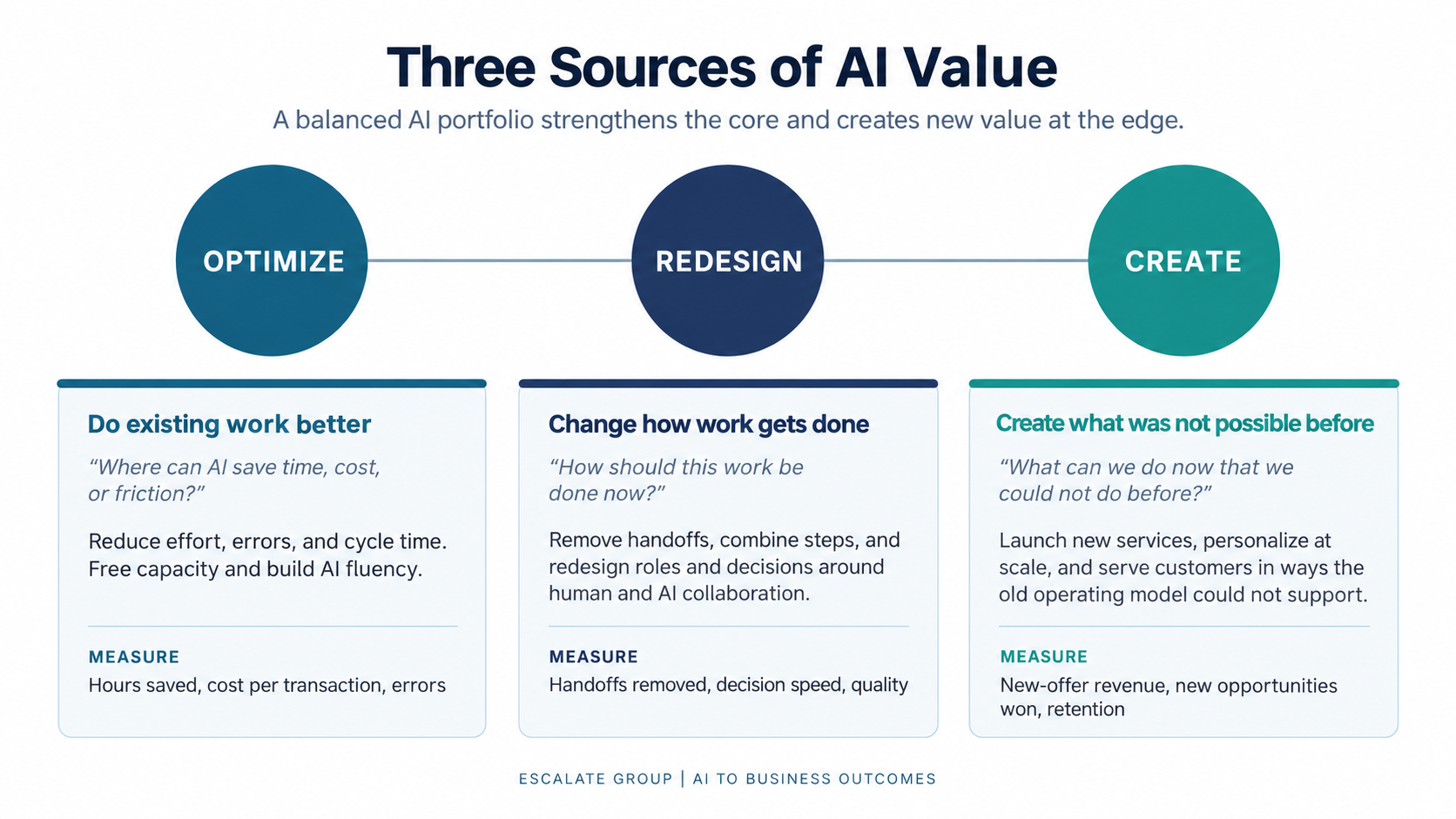
At Escalate Group, we use a simple three-part model to help leadership teams see where their AI portfolio creates value today and where it should expand. Deloitte’s research maps closely to this framing: 37% of organizations report surface-level AI use with minimal process change, 30% are redesigning key processes around AI, and 34% report deeper transformation through new products, services, or reinvented processes and business models.
- Optimize what you already do. Reduce time, cost, friction, and errors in existing work.
- Redesign how work gets done. Change workflows, roles, and decisions around human-AI collaboration.
- Create capabilities that did not exist before. Offer customers, employees, and partners something the business could not previously deliver.
These are three sources of value, not stages that must be completed in sequence. A strong portfolio can pursue all three at the same time: optimize today’s business, redesign how it operates, and experiment with what becomes possible next. The risk is not starting with efficiency. The risk is allowing efficiency to define the full ambition.
3. Optimize What You Already Do
Optimization is where most organizations begin: drafting emails, summarizing meetings, preparing first versions of reports, answering routine questions, and cleaning data. These uses can reduce cost, improve quality, and free capacity. They also help employees build familiarity with AI.
The limitation is that these capabilities are becoming widely available. When competitors have access to similar copilots and assistants, faster drafting alone is unlikely to remain a durable advantage. Optimization matters. Increasingly, it is the baseline, not the differentiator.
There is also a subtler risk. If success is defined only as hours saved, organizations may reinvest those hours into more of the same work. The operating model stays intact, and AI remains a cost program rather than becoming a source of broader business value.
4. Redesign How Work Gets Done
Redesign changes the work itself. Instead of accelerating every step in an existing process, leaders ask which steps, handoffs, and decisions should change. An AI-enabled workflow can carry context across stages, combine previously separate activities, and shift people toward directing, reviewing, and improving the work.
This is the territory we explored in our July article, where we outlined five decisions that define an AI operating model: which workflows to redesign, what authority agents have, where human accountability sits, how employee judgment develops, and how outcomes are measured. Redesign begins to change the shape of the organization, not only its speed.
Redesign can also reveal possibilities that were difficult to see before. If a proposal process that once took three weeks can be completed in three days, the gain isn’t just time. The company may be able to pursue opportunities it previously declined because it could not respond fast enough.
5. Create Capabilities That Did Not Exist Before
Creation is where AI becomes a strategy conversation. The question is no longer only how to improve existing work, but what the business could now offer that was previously too expensive, complex, or slow to deliver.
For mid-market companies, new AI-enabled capabilities may fall into five categories:
- Serving customers differently. Offer a level of responsiveness, availability, or expertise that once required a much larger team.
- Personalizing at scale. Extend relevant, tailored experiences beyond the small group of customers that historically justified the cost.
- Deciding with information that was not economical to synthesize. Combine customer, operational, and market information into decisions in hours, not months.
- Launching services that were previously out of reach. Turn internal expertise into new monitoring, advisory, or subscription offers.
- Operating at a new speed. Respond faster to customer requests, market shifts, and competitive moves.
The following are illustrative possibilities, not case studies or expected outcomes:
- Financial services. A regional lender could use customer and market information to provide small-business clients with faster cash-flow visibility and earlier risk signals, making a valuable service available beyond its largest accounts.
- A mid-sized manufacturer could reduce the time required to prepare a custom quote and test predictive maintenance as a recurring service beyond the original equipment sale.
- Retail and distribution. A distributor could give business customers more relevant assortment and reorder recommendations while serving buyers in multiple languages and time zones.
In each illustration, efficiency still matters. But the strategic value lies in a new offer, a different customer experience, or a market the previous operating model could not support.
6. Why Mid-Market Companies May Have an Advantage
Mid-market companies do not automatically have an AI advantage. Scale, data, talent, capital, and infrastructure still matter. But three characteristics can work in their favor when leaders use them deliberately.
Shorter decision paths. With fewer layers between the CEO and the people closest to customers, an idea may move from discussion to a controlled experiment more quickly.
Closer customer relationships. Direct access to key customers can make it easier to test whether a proposed capability solves a real problem and is worth paying for.
Fewer organizational layers. In some companies, less complexity between functions can make workflow redesign easier, although legacy systems and constraints vary widely across the mid-market.
HCLTech does not establish that mid-market companies outperform large enterprises. It does, however, show that organizations reporting significant AI-driven revenue impact are more likely than their peers to have agile structures that move AI initiatives quickly (64% versus 15%) and cultures that encourage experimentation (54% versus 18%). That evidence supports the importance of agility and learning, not a size-based conclusion. As we noted in Why AI Pilots Fail and How Mid-Market Leaders Make Them Stick, speed of learning matters more than the size of a single experiment.
Mid-market companies do not automatically have an AI advantage. Scale, data, talent, capital, and infrastructure still matter. But three characteristics can work in their favor when leaders use them deliberately.
Shorter decision paths. With fewer layers between the CEO and the people closest to customers, an idea may move from discussion to a controlled experiment more quickly.
Closer customer relationships. Direct access to key customers can make it easier to test whether a proposed capability solves a real problem and is worth paying for.
Fewer organizational layers. In some companies, less complexity between functions can make workflow redesign easier, although legacy systems and constraints vary widely across the mid-market.
HCLTech does not establish that mid-market companies outperform large enterprises. It does, however, show that organizations reporting significant AI-driven revenue impact are more likely than their peers to have agile structures that move AI initiatives quickly (64% versus 15%) and cultures that encourage experimentation (54% versus 18%). That evidence supports the importance of agility and learning, not a size-based conclusion. As we noted in Why AI Pilots Fail and How Mid-Market Leaders Make Them Stick, speed of learning matters more than the size of a single experiment.
7. Measure Capability, Not Just Efficiency
What leaders measure shapes what teams build. If AI ROI is assessed mainly through cost and time, the portfolio will naturally favor efficiency projects. A balanced scorecard should also include workflow and capability outcomes.
| Value source | Guiding question | What to measure |
| Optimize | Where can AI save time, cost, or friction? | Hours saved, cost per transaction, error rates, cycle time |
| Redesign | How should this work be done now? | Handoffs removed, end-to-end cycle time, decision speed, outcome quality |
| Create | What can we do now that we could not do before? | Revenue from new offers, customers served per employee, win rate on opportunities previously declined, retention, share of wallet |
We recommend that every AI portfolio include at least one initiative measured by new-capability outcomes, even if the experiment starts small. The goal is not to abandon efficiency. It is to keep efficiency from becoming the only value the organization knows how to recognize. HCLTech found that AI Leaders are more than three times as likely as followers to be guided by clear business use cases and measurable value (73% versus 22%). Measurable value does not have to mean cost savings.
.
8. Three Moves to Start This Quarter
- Map your current AI portfolio. List every active initiative and place it across Optimize, Redesign, or Create. A portfolio concentrated in optimization isn’t a failure; it signals that the next investment should broaden the value mix.
- Ask the capability question in your next leadership meeting. Choose one customer segment and ask: If the cost of analysis, personalization, and response time fell dramatically, what would we offer these customers that we cannot offer today? Capture the possibilities before evaluating them.
- Run one new-capability experiment. Choose a promising idea, define success in customer and commercial terms, and test the smallest responsible version with a small group of real customers within 60 to 90 days, where appropriate. Keep human accountability clear and adapt the pace to the risk and regulatory context.
Leaders should also work with AI directly. CEOs do not need to become technical specialists. But they should learn to frame problems, provide context, and work iteratively with AI. Clear, well-structured prompts are part of that fluency. Direct experience sharpens strategic judgment about what AI can and cannot do.
9. The ExO Perspective: From Scarcity to Abundance
At Escalate Group, our work is guided by the Exponential Organizations (ExO) methodology: achieving greater impact by using information, technology, communities, and external resources rather than adding physical assets and headcount at the same rate as growth. The Create opportunity reflects that mindset applied to AI.
Traditional operating models are often built around scarcity. Expertise is limited, analysis is expensive, and personalized service is reserved for the customers who justify the cost. AI can change some of those constraints. As expertise, analysis, and responsiveness become more available, the strategy question shifts from how to ration them to what new value they make possible.
In ExO terms, AI gives leaders an opportunity to work on both sides of transformation: improve and redesign the core while experimenting at the edge with capabilities, services, and business models that were not previously viable. That is why we return to a simple CEO question: Are we using AI primarily to make the old operating model cheaper, or to make a better operating model possible?
Conclusion:
Efficiency was the right place to start with AI. It is the wrong place to stop. Across the studies cited here, productivity gains are more common than revenue impact, and a disproportionate share of economic value is concentrated among a smaller group of organizations.
Mid-market companies do not need to choose between improving today’s business and exploring what comes next. They can pursue both deliberately: optimize to strengthen the core, redesign to change how work happens, and create to test new value at the edge. The objective is not simply to operate more efficiently. It is to build a business that can compete differently.
If your leadership team is ready to move beyond time savings, we can help you map your AI portfolio, identify a new-capability opportunity, and design a responsible experiment to test it. Learn more about how we work through the Escalate Group AI Studio.
Frequently Asked Questions
What are the three sources of AI value?
The three sources are Optimize, Redesign, and Create. Optimize makes existing work faster, less costly, or more reliable. Redesign changes workflows, roles, and decisions around human-AI collaboration. Create tests capabilities the business could not previously deliver. They are not sequential stages; a balanced portfolio can pursue all three at once.
Why are most companies not seeing revenue impact from AI?
AI can produce revenue, but many organizations still direct and measure it primarily as an efficiency tool. HCLTech’s 2026 research found that 51% of organizations measure AI ROI primarily through efficiency and cost savings, while only 9% connect it primarily to revenue growth. That measurement choice is one reason growth opportunities can remain underdeveloped.
Is efficiency-focused AI still worth pursuing?
Yes. Efficiency gains can free capacity, improve quality, and build organizational confidence. The problem is treating efficiency as the full destination. As widely available AI capabilities spread, some productivity gains may become a competitive baseline rather than a lasting advantage.
How can a mid-market company identify new AI-enabled capabilities?
Start with one customer segment and ask what you could offer if the cost and time required for analysis, personalization, or response fell dramatically. Prioritize ideas that address a verified customer need, then test the smallest responsible version with real customers.
How should leaders measure the ROI of AI beyond cost savings?
Add workflow and capability metrics alongside cost and time. Depending on the initiative, these may include revenue from a new offer, customers served per employee, win rate on previously declined opportunities, decision speed, retention, or share of wallet.