How to Make AI Work in Mid-Market Companies

How to Make AI Work in Mid-Market Companies

November 19, 2025

AI&Web3 Digital Revolution transforming business Strategy for CEOs

To make AI work in mid-market companies, leaders need to move beyond pilots to deliver operational value that redesigns workflows, decision-making, and business performance for measurable impact.         

Introduction

For the past two years, one question keeps coming up in conversations with mid-market CEOs:

“We’ve been experimenting with AI, but we can’t seem to get it to actually do anything meaningful for the business. What are we missing?”

The frustration is real and well-founded.

Many companies launch AI pilots with promising early results, only to find that those experiments never translate into operational value. As we explored in How AI Transforms Team Collaboration and Innovation, meaningful transformation depends on how people work with technology, not simply on adopting new tools. The gap between “it works in a demo” and “it works in our business” has become one of the defining challenges of this era.

But something is beginning to change.

Over the past several months, a growing number of mid-market organizations have successfully crossed the line from experimentation to production deployment. The lessons from those successes reveal a pattern worth paying close attention to.

Why the Pilot-to-Production Gap Exists

When AI pilots fail to scale, the root cause is rarely the technology itself. The tools are capable. The models are powerful.

The real barriers are almost always organizational.

Across many companies, three patterns consistently appear when pilots stall.

Start with the Right Business Problem

Many organizations launch AI pilots because they feel pressure to “do something with AI,” not because they have identified a specific, high-value process that AI can genuinely improve.

Without a clearly defined business outcome, pilots often produce interesting insights but little measurable impact. Enthusiasm fades, priorities shift, and the project quietly disappears.

Treat AI as a Workflow Change, Not a Standalone Tool

Dropping an AI tool into an existing process without redesigning how work actually gets done rarely produces meaningful results.

The value of AI is not just in the model. It emerges when the technology is integrated into how teams operate, how decisions are made, and how workflows are structured.

Prioritize Data Readiness and Change Management

AI depends on clean, accessible data — and on people who trust the outputs enough to use them. For leaders thinking about governance as they scale, the NIST AI Risk Management Framework offers a useful reference point for building trustworthy and responsible AI practices.

Both requirements are harder than they appear from the outside. Data often lives in disconnected systems, and employees are understandably cautious about relying on unfamiliar tools that may affect their work.

How to Make AI Work in Mid-Market Companies

The mid-market organizations that are successfully moving AI from pilot to production tend to follow a consistent set of practices.

Interestingly, they are not always the companies with the largest technology budgets. In many cases, success comes from applying focused investments to well-defined operational problems.

Focus on High-Frequency, High-Pain Processes

Instead of trying to implement a broad “AI strategy,” successful organizations begin with one operational process that:

  • happens frequently.
  • Consumes significant time.
  • produces inconsistent results.

Processes such as order management, customer inquiry routing, financial reconciliation, or supply chain exception handling often fit this pattern.

When AI improves a process that happens thousands of times per month, even small efficiency gains quickly translate into measurable business value.

They Design Around the End User

AI systems that succeed are designed around the people who will use them every day.

This means involving frontline employees early, keeping interfaces simple, and ensuring that users can easily review or correct AI outputs.

Trust is built incrementally. The fastest way to destroy that trust is to deploy a system that employees feel is unreliable or disconnected from their daily work.

Measure Business Impact, Not Technical Metrics

Successful deployments focus on business outcomes rather than technical benchmarks. That same business-first mindset is reflected in our article on Solving AI Challenges for Mid-Market Growth, where scalability, security, and adoption must work together.

Instead of measuring model accuracy or latency, they measure metrics such as:

  • time saved per transaction
  • faster customer resolution
  • reduced operational errors
  • improved service consistency

When leaders and teams can clearly see the operational impact, the initiative gains momentum and long-term support.

Why Leadership Involvement Matters

One of the clearest indicators that an AI initiative will succeed is active leadership engagement.

This does not mean CEOs need to become data scientists. But they do need to ask the right questions:

  • What process are we changing?
  • How will we know the solution is working?
  • What happens when the AI is wrong?
  • Who owns the system after the pilot ends?

Organizations where leadership stays engaged tend to move faster from experimentation to real operational impact.

The reason is simple: scaling AI is ultimately about changing how people work. That kind of transformation requires visible leadership commitment.

A Practical Framework for Moving from Pilot to Production

Across organizations that have successfully operationalized AI, a repeatable structure tends to emerge.

1. Define the Business Outcome First

Before selecting tools or models, clearly articulate the business result you want to achieve and how success will be measured.

This outcome becomes the guiding filter for every technical and operational decision that follows.

2. Map the Current Process in Detail

Understand the process in detail:

  • where time is lost.
  • where errors occur.
  • where human judgment is required.
  • where work is simply repetitive.

This clarity often reveals where AI can provide the greatest leverage.

3. Design the Future Workflow Before Building the AI

The temptation is to start with technology. Resist it.

First, design the improved workflow, then determine where AI fits within that system.

4. Run a Short, Focused Pilot with Real Stakes

A two-to-three-week pilot on a real process with real teams and real metrics often provides more insight than months of experimentation in a sandbox.

5. Build for Operations from Day One

Even during the pilot phase, consider how the solution will be maintained, monitored, and improved. For a practical perspective on operationalizing machine learning and creating repeatable delivery pipelines, Google Cloud’s guide to MLOps and continuous delivery in machine learning is a helpful public resource.

Solutions that are not designed for operational ownership tend to fade once the initial excitement passes.

The Strategic Window for Mid-Market Companies

The mid-market companies that operationalize AI over the next 12 to 18 months are likely to build advantages that are difficult for competitors to replicate.

Not because the technology itself is exclusive, it is not.

However, the organizational capability to deploy AI repeatedly, the supporting data infrastructure, and the teams trained to work with these systems take time to build.

Companies that develop this capability early will compound their advantage.

Companies that remain stuck in pilot mode may eventually find themselves racing to catch up.

Conclusion

For many mid‑market companies, the challenge with AI is no longer understanding its potential. The challenge is turning experimentation into operational value.

Moving from pilot to production requires more than adopting new tools. It requires clarity about the business problem being solved, redesigning workflows around real outcomes, and building the organizational capability to deploy AI repeatedly and at scale.

The organizations that succeed tend to follow a similar path: they start with a well‑defined operational problem, involve the people who will use the system every day, measure business impact rather than technical metrics, and maintain active leadership engagement throughout the process.

When these elements come together, AI stops being a series of disconnected experiments and becomes a practical engine for efficiency, innovation, and growth.

For leadership teams, the key question is no longer whether AI matters. It is far more practical:

What is the one operational process we could transform in the next 90 days,  and what would it take to turn that improvement into a repeatable capability across the organization?

Answering that question is often the first real step toward turning AI from a pilot project into a lasting competitive advantage.

Organizations ready to take that next step can also explore more insights in our Escalate Group blog or learn more about our approach in the AI Studio.

How AI Transforms Team Collaboration and Innovation

How AI Transforms Team Collaboration and Innovation

October 28, 2025

AI&Web3 Digital Revolution transforming business Strategy for CEOs

AI is transforming how teams think, collaborate, and innovate. Explore how human AI co-creation reduces stress, boosts creativity, and reshapes organizational culture and what leaders can do to accelerate the shift.

Introduction:  

Escalate Group has long emphasized that meaningful transformation begins with people, not tools. Insights from Harvard Business School’s When AI Joins the Team, Better Ideas Surface reinforce a pattern often seen across transformation initiatives: AI reshapes how teams think, connect, and innovate together. The impact goes far beyond automation. It influences how individuals collaborate, generate ideas, and gain confidence in their own creativity, as highlighted in the Harvard Business School research.

As organizations integrate data, AI, and new digital capabilities, the most significant breakthroughs emerge when teams approach AI as a creative partner, one that expands human capacity rather than replacing it.
To explore how digital transformation accelerates this shift, see our AI transformation approach.


What the Research Shows and Why It Matters

The Harvard study, conducted with Procter & Gamble, engaged nearly 800 professionals who generated ideas with or without AI support, individually or in teams. The findings reflect a clear trend:

  • Teams using AI were three times more likely to produce top-tier ideas.
  • Individuals collaborating with AI matched the performance of two-person teams without it.
  • AI-assisted work finished 13–16% faster.
  • Stress decreased, and engagement rose once participants gained confidence with the technology.

These results mirror what is happening in organizations adopting AI today. When technology helps teams explore possibilities, connect diverse insights, and test ideas with less friction, creativity becomes more natural—and more frequent.

Beyond the Data: The Human Dynamics of Innovation

The research reveals a truth that consistently surfaces in transformation efforts: the most significant barrier to innovation is rarely the technology—it is the human response to it.

  1. AI can help teams become braver, not just more efficient.

Early stages of AI adoption often involve uncertainty. People question whether the technology will outperform them, expose weaknesses, or disrupt their roles. This emotional hesitation is common.

But as teams begin experimenting and see AI broadening their perspectives, hesitation gives way to curiosity. Work feels less constrained. Ideas expand. Risk-taking becomes more comfortable.

This shift appears across industries:

  • In e-commerce, AI improves personalization and accelerates experimentation cycles.
  • In financial services, AI blends behavioral and risk data to reveal opportunities that might otherwise go unnoticed.

These changes strengthen not just productivity, but creative confidence.

  1. Co-creation between humans and AI unlocks deeper insights.

Once trust develops, teams move beyond simple AI assistance and step into co-creation.
Here, humans and algorithms iterate together, challenging assumptions and strengthening ideas.

Further insights from MIT Sloan show that human–AI partnerships generate the strongest outcomes when people and AI complement each other’s strengths rather than overlap roles. The principle is simple: humans bring context, imagination, and judgment; AI brings pattern recognition, scale, and speed. Together, they elevate the quality of thinking.

  1. Emotional readiness is a vital indicator of transformation.

One of the study’s most important insights is emotional: stress drops and engagement rises once individuals feel supported by AI rather than judged by it.

This shift is not a minor detail; it is a critical marker of readiness. When people feel safe to explore, question, test, and revise ideas, collaboration becomes lighter and innovation more fluid.

Tracking how teams feel, not just what they produce, provides leaders with a clearer measure of progress.

What Leaders Can Do Now

Moving from AI adoption to AI-enabled transformation requires rethinking how teams work and learn. Four leadership shifts help accelerate this journey:

  1. Treat AI as a teammate.

Ask how teams can work differently with AI, not just what AI can automate.

  1. Invest in human capability.

Training people to prompt, iterate, and collaborate with AI reduces friction and builds confidence.
Programs such as ExO Sprints can help teams rapidly build these new capabilities.

McKinsey’s research on the human side of AI adoption shows that organizations achieve greater productivity when they design jobs that put people before technology, empowering teams to focus on creativity and collaboration.
(See: McKinsey – The Human Side of Generative AI.)

  1. Redesign workflows for co-creation.

Structure work so humans and AI contribute continuously rather than sequentially.

  1. Measure emotional engagement.

Curiosity, confidence, and psychological safety are essential ingredients for sustained innovation.

These shifts are cultural in nature, and leadership sets the tone.

From Compliance to Ownership

Transformation efforts often begin with compliance: employees follow new steps and tools because they must. But true momentum arrives when people experience how AI makes their work easier, clearer, or more interesting.

The moment the question changes from “Do I have to use this?” to “What else can this enable?” the transformation becomes self-sustaining.

That spark where AI becomes an ally rather than an obligation is the turning point every organization aims to reach.

Conclusion: The Future of Collaboration: Human + Machine

Organizations that thrive in the next era will not rely on AI as a standalone solution. They will reimagine collaboration itself. The future is not about choosing between human intelligence and artificial intelligence but about integrating both.

The Harvard study offers a preview of this reality: AI will sit alongside every team, from strategy to operations to product development, supporting insight, creativity, and decision-making.

The critical question for leaders is no longer if AI will join their teams, but how prepared their people are to partner with it.

Organizations preparing for this journey can explore next steps with our team at Escalate Group.

Empowering People with AI: How Workshops Unlock Confidence and Innovation

Empowering People with AI: How Workshops Unlock Confidence and Innovation

Septiembre 30, 2025

By Olga Calvache

Escalate Group, AI Workshops

AI upskilling is no longer optional, it’s essential. Discover lessons from Escalate Group’s workshops on how leaders can empower teams, foster collaboration, and build AI confidence for the future of work. 

Introduction: 

At Escalate Group, we’re building on the experience we’ve gained guiding organizations in innovation and exponential thinking since 2017.

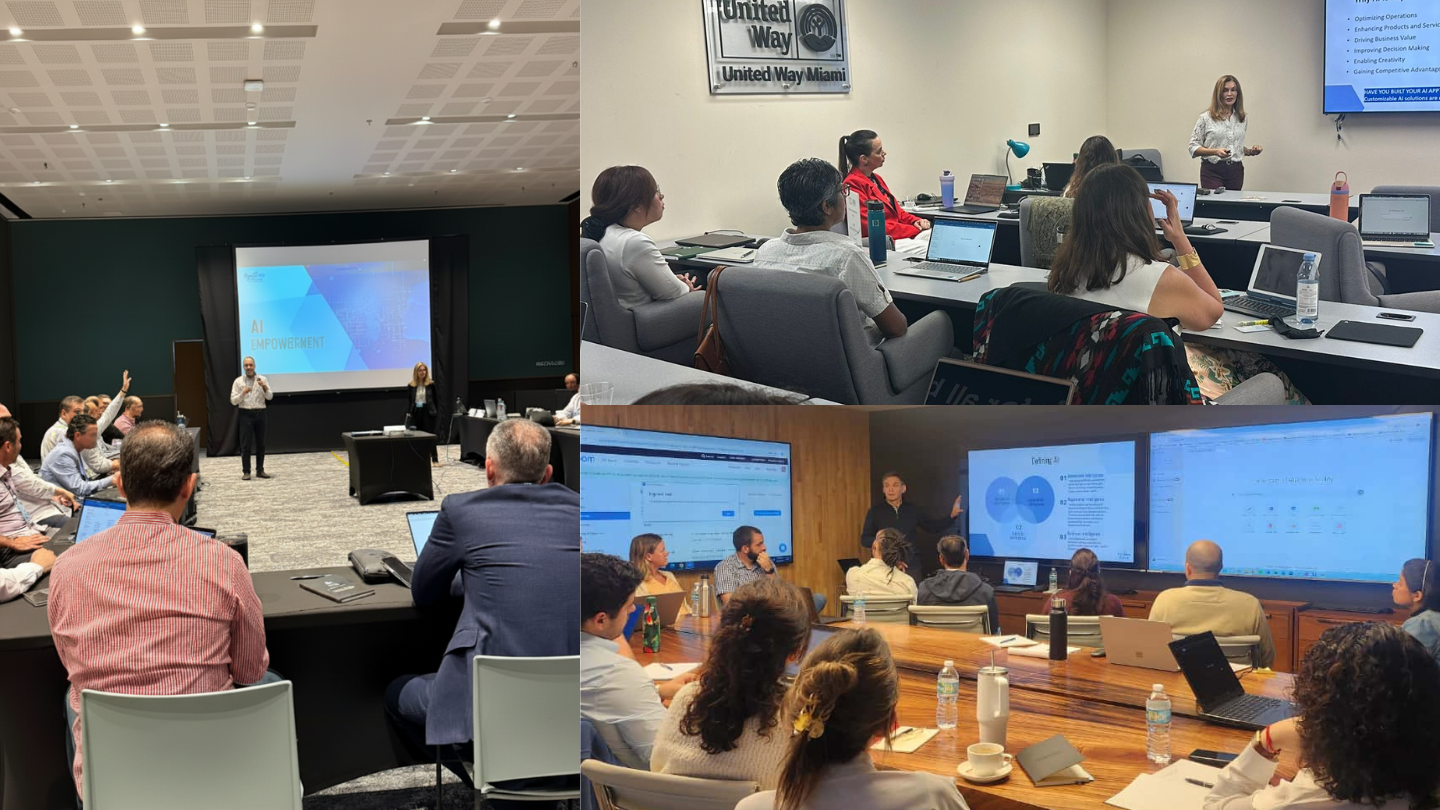
For more than two years, I’ve been leading AI Empowerment Workshops for executives and teams across industries such as healthcare, finance, retail, and manufacturing.

These sessions have never been about showcasing the latest tools. They’ve been about helping people rethink the way they work, building confidence, sparking curiosity, and showing what’s possible when AI becomes a trusted ally in daily routines.

And one thing is clear: AI upskilling is no longer optional, it’s essential

Why AI Upskilling Matters Now

AI is transforming the nature of work at an unprecedented pace. Leaders everywhere are asking: How do we prepare our teams for this new reality?

The challenge isn’t just technological. It’s cultural. Resistance often comes from habits, fears of making mistakes, or simply not having the time to explore new tools. That’s why our approach puts mindset before technology.

When people see how AI can handle repetitive tasks — from summarizing reports to generating client-ready presentations — they don’t just save time. They start asking better questions, and they begin to imagine how their work could be redefined.

More on the topic: Reskilling in the age of AI from Harvard Business Review

What We’ve Learned from Our Workshops

Through more than a dozen AI upskilling sessions, three things have consistently worked:

Start with motivation. People adopt AI when they understand the “why” and see personal benefits.

Make it real. Using client-specific data makes the impact tangible and the “aha” moments immediate.

Encourage collaboration. Small-group exercises not only build skills but also foster a stronger team culture.

The results speak for themselves:

– 90% of participants reported they could save five or more hours per week using AI after the workshop.

– One client automated three recurring tasks within 48 hours, freeing their team for more strategic work.

Most importantly, participants walk away excited to continue experimenting and to share what they’ve learned with colleagues. This creates momentum and a ripple effect across the organization.

How to Start in Your Organization

If you’re a leader wondering how to begin, here are three principles we’ve seen make the difference:

Set the right mindset. Make it safe to experiment. Remind teams that “done is better than perfect.”

Look at workflows with fresh eyes. Ask: What can I make easier today so I can focus on higher-value work tomorrow?

Invest in small wins. Big transformations start with small successes that prove the value and build confidence.

The Future of Work with AI

The organizations that thrive won’t just be AI-literate, they’ll be AI-confident. They’ll empower every employee to build their own team of digital assistants, amplifying human potential rather than replacing it.

This is more than upskilling. It’s a cultural shift toward continuous learning, collaboration, and innovation. And it’s already happening.

Check our Innovation Sprints

Conclusion: A final reflection

At Escalate Group, our purpose is to help companies unlock digital value. Through our workshops, advisory services, and innovation sprints, we guide leaders and teams to embrace AI not as a challenge, but as an opportunity for growth.

My advice to leaders is simple: start small, start now, and start with your people. Because once your team experiences what’s possible, there’s no going back.

Scaling Smarter: AI Infrastructure Strategies for 2025

Scaling Smarter: AI Infrastructure Strategies for 2025

August 27, 2025

AI&Web3 Digital Revolution transforming business Strategy for CEOs

In 2025, AI infrastructure has become a competitive battleground. For mid-market and growth-stage leaders, the infrastructure strategy chosen now will define future ability to scale, innovate, and lead in an AI-first era. 

Introduction: Strategic Insights on AI Infrastructure for Scaling Businesses       

Recent insights from leaders across Latin America and the United States reveal a defining truth: AI infrastructure is no longer a future-facing concept, it has become today’s competitive battleground.

For growth-stage and mid-market CEOs managing organizations with $20M+ in annual revenue and 100–1,500 employees, the infrastructure choices made today will determine their ability to scale, innovate, and lead in this AI-first era.

This briefing explores global shifts in AI infrastructure and translates them into strategic decisions for organizations preparing for growth in 2025.

1. Hyperscale Expansion and Infrastructure Demand

The top five U.S. hyperscalers: Amazon, Microsoft, Google, Meta, and Oracle, invested $211 billion in capital expenditures in 2024, primarily to meet the soaring demand for AI infrastructure (Moody’s, 2025). This surge is not a bubble; it represents the backbone of the next economy.

For scaling businesses, this wave of investment is democratizing access. Companies no longer need to build billion-dollar data centers—what matters is knowing how to leverage what hyperscalers are creating and when to partner with those capable of handling the heavy lifting.

Examples underscore this trend:

CoreWeave’s $1.6B acquisition of Core Scientific consolidated compute and energy assets at scale, reducing time-to-market for AI workloads.

OpenAI’s Stargate project with Oracle, a multi-billion-dollar, 4.5-gigawatt initiative, highlights how mega-partnerships are reshaping the digital backbone of global business. Read the Stargate project here

For mid-market leaders, the lesson is clear: scale AI compute through hybrid, capital-efficient approaches without shouldering capital expenditures (CapEx) burdens.

As highlighted in How Mid-Market CEOs Can Win the AI Revolution, the real opportunity lies not in owning infrastructure but in knowing when to leverage it.

2. Regional Dynamics: Energy, Geography, and Opportunity

Regional conditions are shaping AI infrastructure strategies in different ways:

In Latin America, countries such as Brazil, Chile, and Colombia benefit from abundant renewable energy sources, with Brazil targeting 97% renewable energy by the end of 2025. However, the ability to deliver enterprise-grade grid power at scale still faces credibility and logistical challenges.

In the United States, established hubs like Phoenix and Northern Virginia are confronting power shortages and rising lease costs, driving expansion into new markets such as Wichita Falls, TX, and North Carolina.

The takeaway: energy credibility, latency, and price elasticity must become central factors in infrastructure planning.

3. New AI-First Infrastructure Models

A new generation of AI-first infrastructure providers is reshaping the landscape:

Nebius offers full-stack AI-as-a-Service, combining infrastructure, frameworks (CUDA, TensorFlow), and orchestration tools. This model reduces deployment friction and accelerates scalability for mid-market organizations.

Marathon Digital Holdings (MARA) has leveraged its crypto infrastructure and energy independence through wind and flare gas to pivot into AI inference—a clear example of agile strategy.

Nvidia, once viewed primarily as a chipmaker, has evolved into a full-stack infrastructure leader. By 2025, more than 80% of global AI compute clusters will run on Nvidia hardware, and over 60% of its projected $120 billion in revenue will come from AI data centers. With offerings such as NIMs (Nvidia Inference Microservices), Omniverse, and BioNeMo, Nvidia now delivers complete stacks, from GPUs and networking to enterprise-ready AI services.

“Nvidia’s portfolio now spans GPUs to inference orchestration, with offerings such as NIMs accelerating enterprise adoption.”

For scaling organizations, the signal is clear: infrastructure is not just a back-end concern, it is a strategic growth lever. Partner selection must focus not only on compute capacity but also on accelerating time-to-solution.

4. The Hidden Costs of Stalling After Experimentation

The momentum is undeniable: 91% of mid-market companies are experimenting with generative AI (RSM 2025 AI Survey). Yet scaling remains a challenge:

  • 39% lack in-house expertise to move beyond pilots.
  • 41% identify data quality as a barrier.

Experimentation is critical, but without a clear bridge to operational scale, organizations risk fatigue, missed timing, and competitive setbacks. Rising infrastructure costs, energy limitations, and hyperscaler capacity constraints make inaction a strategic liability.

The most successful companies treat experimentation as more than technical testing. They use it to:

  •  Align teams around shared priorities.
  • Validate use cases with business impact.
  • Prepare systematically for scaling.

AI Infrastructure Maturity Model

The journey to maturity can be mapped in four stages:

  1. Experimentation – early testing with limited investment.
  2. Pilot Projects – small-scale deployments tied to specific use cases.
  3. Tactical Deployment – cross-functional operational integration.
  4. Strategic Integration – AI as a core business driver with aligned infrastructure, governance, and leadership accountability.

“This reflects the broader shift we discussed in AI & Web3: The Digital Revolution Every CEO Must Prepare For, where convergence of technologies is rewriting growth strategies.”

5. Strategic Infrastructure Moves for Scaling Organizations

Across industries such as finance, healthcare, retail, and manufacturing, four priorities stand out:

Build for flexibility: cloud-first is strong, hybrid is often stronger. Avoid lock-in.

Validate partners: confirm compliance, scalability, and power availability.

Tie infrastructure to outcomes: every investment should deliver faster insights, better customer experiences, or new revenue streams.

Co-create solutions: collaborate with providers, whether hyperscalers like Microsoft Azure or specialized platforms like Nebius—to design infrastructure aligned with growth priorities, rather than retrofitting generic solutions.

Conclusion: Leadership in the Age of Infrastructure Intelligence

This moment is not about servers or racks—it is about architecting the ability to learn, adapt, and scale intelligently.

AI infrastructure has moved from being a technical concern to becoming a leadership agenda item. The central question for executives is clear:

Are you building your AI advantage, or are you waiting for hyperscalers to carry you there?

The organizations that lean in now will define the competitive landscape of the AI-first economy.

Solving AI Challenges for Mid-Market Growth

Solving AI Challenges for Mid-Market Growth

July 17, 2025

AI&Web3 Digital Revolution transforming business Strategy for CEOs

Mid-sized companies often hit roadblocks with AI—talent gaps, security issues, and lack of scalability. This guide from Escalate Group offers practical strategies to turn AI complexity into measurable business growth.

Introduction: Practical Takeaways for Transforming AI Complexity into Business Growth             

What’s at stake: Mid-sized companies risk falling behind if they don’t address AI’s hidden challenges—skills gaps, security risks, and stalled implementations. This guide offers clear, actionable solutions from Escalate Group to help you unlock real ROI, fast.

Artificial Intelligence (AI) is rapidly reshaping industries, but many mid-sized companies are struggling to scale AI successfully. A recent Harvard Business School article highlights three common pitfalls companies face with AI: lack of internal talent, cybersecurity gaps, and non-scalable implementation. These are precisely the challenges Escalate Group is built to solve.

1. Upskilling Mid-Market Teams for AI Transformation

Too often, companies invest in new AI tools but leave their teams behind. Without upskilling, the result is a fragmented workforce, some fluent in AI, others unsure how to engage with it.

At Escalate Group, we believe that real AI transformation starts from within. Our education services, coaching programs, and Exponential Organizations (ExO) workshops are designed to:

– Build AI literacy across departments—from HR to Sales to Legal

– Develop ethical and governance-aware leaders

– Embed AI into workflows in a way that’s practical and scalable

We create safe-to-try environments that foster psychological safety, continuous learning, and bold experimentation, crucial for any organization’s AI journey.

2. AI Security Strategy for Mid-Market Organizations

AI isn’t just powerful, it’s vulnerable. From data poisoning to model manipulation, mid-market organizations must stay ahead of increasingly sophisticated threats.

Through our strategic advisory services and Microsoft and Fulcrum Digital ecosystems, Escalate Group helps companies:

– Conduct AI-specific risk assessments

– Establish zero-trust architectures (learn more about Zero Trust principles from Microsoft)

– Maintain compliance in high-stakes sectors like finance and healthcare

We also integrate governance, compliance, and platform partners like Microsoft Azure AI to ensure robust and responsible AI deployment.

3. Driving Scalable AI ROI in the Mid-Market

AI is not a standalone solution. To drive sustainable value, it must be integrated into a company’s core business strategy.

Escalate Group enables this through:

– Tailored assessments of business and data readiness

– MVP development through innovation sprints that deliver ROI in as little as 6 weeks

– Measurable impact using KPI frameworks such as FTE reduction, time saved, and cycle time compression

Typical results: 60–80% reduction in manual work through agentic workflows and AI copilots.

We also help clients embrace agentic workflows, autonomous systems that proactively collaborate with humans—to move beyond basic automation to AI-native operating models.

Bonus: Is Your Organization AI-Ready?

Use this quick checklist to assess readiness:

– Executive alignment around AI goals and priorities

– Clear AI use cases tied to business value

– Data availability and accessibility

– Identified department-level champions

– Governance and compliance baseline in place

Conclusion: Why it Matters Now

The AI wave isn’t slowing down. But only those who address talent, security, and scalability together will ride it successfully.

Unlike generic AI vendors, Escalate Group delivers culturally aligned, fast-to-implement solutions using the ExO framework, Microsoft Copilot, and scalable innovation sprints tailored to mid-market realities.

By combining AI innovation with deep sector knowledge, agile methodologies, and Microsoft’s tech stack, as reflected in our approach to Exponential Growth and Impact, we help our clients transform today’s complexity into tomorrow’s advantage.

Let’s unlock measurable AI results in your organization.
Book a 20-minute executive briefing or explore how our AI Studio can deliver rapid ROI with minimal disruption.

AI & Web3: The Digital Revolution Every CEO Must Prepare For

AI & Web3: The Digital Revolution Every CEO Must Prepare For

May 20, 2025

AI&Web3 Digital Revolution transforming business Strategy for CEOs

AI and Web3 are no longer future techs, they’re reshaping industries. CEOs must act fast to integrate these tools or risk falling behind. Discover how to turn disruption into opportunity with innovative strategies and emerging digital models built for growth.

Introduction: A New Business Reality is Emerging                           

Imagine waking up one day to find that your industry has been completely reshaped not by a competitor, but by a new wave of digital transformation that you didn’t see coming. Sounds dramatic? Perhaps. But this is the reality many businesses face today as artificial intelligence (AI) and Web3 technologies redefine how value is created, exchanged, and captured. 

For many CEOs, these concepts might seem like abstract buzzwords—far removed from the pressing realities of revenue growth, operational efficiency, and customer retention. Yet, ignoring these trends is no longer an option. The AI-powered, decentralized internet isn’t just the future; it’s happening now. The question is, will you harness it to future-proof your company, or will you be left playing catch-up? 

At Escalate Group, we help mid-market enterprises and scale-ups navigate this complex transformation, integrating AI and blockchain technologies to create sustainable growth. This article is not about theory; it’s a call to action for CEOs who want to turn disruption into opportunity. 

Chris Dixon’s Vision: A Decentralized, AI-Powered Internet 

Chris Dixon, a leading investor at a16z, paints a compelling picture of the next evolution of the internet—one where AI and crypto (blockchain technology) converge to build a more open, decentralized, and intelligent digital economy. 

Let’s break this down into key business implications: 

1. AI & Crypto Synergy:  These aren’t just separate technologies. AI is revolutionizing content, automation, and decision-making, while blockchain introduces trust, security, and decentralization.

Business Takeaway: Companies that leverage both can create new, more efficient customer experiences and business models. For example, SaaS companies can integrate blockchain-based smart contracts to automate subscriptions and ensure payment transparency, reducing churn and improving customer trust. 

2. Decentralization: Instead of relying on Big Tech monopolies, blockchain enables direct interactions between businesses and customers.

Business Takeaway: Retail scale-ups can use blockchain to enhance supply chain transparency, reducing fraud and ensuring ethical sourcing. 

3. New Economic Models: The old internet relied on ad-driven models. The next phase introduces token economies, smart contracts, and AI-generated marketplaces.

Business Takeaway: How can your business benefit from new monetization models that reward engagement and innovation? AI-driven marketplaces are already helping manufacturers optimize inventory and pricing strategies dynamically. 

4. AI as the New Media: AI is transforming how content is created, curated, and consumed.

Business Takeaway: B2B companies can leverage AI-generated marketing campaigns that are verified on blockchain for authenticity, preventing fraud and enhancing brand trust. 

Colin Tedards’ Cycle: Navigating the AI Investment Wave 

If Dixon describes the ‘why’ of the future internet, investor Colin Tedards explains the ‘how’—specifically, the business cycle of AI adoption and investment. Understanding this cycle can help you position your company strategically. 

Three Phases of AI Adoption: 

1. Hardware (Current Phase):  This is the foundational layer, with companies investing in AI infrastructure (GPUs, cloud computing, etc.).

CEO Consideration: Even if your business isn’t in the hardware industry, how will AI infrastructure impact your operations? Retailers and manufacturers should consider evaluating AI-driven logistics optimization to enhance efficiency and reduce costs. 

2. Software & Infrastructure (Emerging Phase): AI models, platforms, and automation tools are becoming more accessible to businesses of all sizes.

CEO Consideration: What AI-powered software solutions can optimize your supply chain, customer service, or product innovation? Financial services firms, for instance, are using AI-powered fraud detection algorithms to mitigate risk. 

3. Applications (Future Growth Phase):  AI will become embedded in everyday business applications, transforming entire industries.

CEO Consideration: Have you begun planning for how AI will reshape your industry’s business model in the next five years? Companies adopting AI-driven predictive analytics now will be able to make smarter, faster decisions ahead of the competition. 

Understanding where your business fits into this cycle will help you make smarter investments in AI and Web3 technologies before your competitors do. 

Connecting the Dots: A CEO’s Action Plan 

The key takeaway here is that AI and Web3 are not separate trends. They are converging to create a fundamentally new internet, one that is decentralized, intelligent, and more transparent. 

For CEOs of mid-market enterprises and scale-ups, this means opportunities if you take action now. 

Five Practical Steps to Future-Proof Your Business, considering ROI 

1. Start Learning: Dedicate time to understanding the fundamentals of AI and blockchain. CEOs who invest in AI education and industry events experience a 20-30% improvement in their confidence in tech adoption. 

2. Strategic Dialogue: Engage your leadership team in discussions about how these technologies could impact your industry. Companies that embed AI into strategic planning see a 10-15% increase in operational efficiency. 

3. Pilot Projects: Start with small-scale AI or blockchain initiatives to gain practical experience. Businesses that launch AI pilots report 2- 5x ROI within 12-18 months. 

4. Partnership Ecosystem: Identify strategic partners in the AI and Web3 space to accelerate innovation and drive growth. Firms that partner with AI/crypto startups experience 15% faster go-to-market times. 

5. Long-Term Vision: Integrate future internet trends into your company’s strategic planning, not just as one-off initiatives. Eighty-five percent of digitally transformed companies outperform their competitors. 

Final Thoughts: Embrace the Change, Seize the Future 

The next wave of digital transformation is already here. AI and Web3 technologies are not futuristic concepts they are actively reshaping industries. The companies that recognize this shift and act decisively will gain a lasting competitive advantage. 

At Escalate Group, we specialize in helping businesses like yours navigate this transition. Whether through strategic advisory, innovation sprints, or digital transformation workshops, we provide hands-on guidance to turn disruption into growth. 

Conclusion: 

AI and Web3 are not just buzzwords; they are actively driving competitive advantages across industries. Scale-ups that integrate AI see operational efficiencies improve by up to 40%, while those leveraging Web3 unlock new business models. The key question isn’t whether these technologies will impact your business, it’s whether you’ll act fast enough to benefit from them.