How SMEs Can Thrive in the AI Era

How SMEs Can Thrive in the AI Era

Aug 27, 2024

Automatización de procesos en la manufactura

In an era where artificial intelligence (AI) is reshaping industries, small and medium-sized enterprises (SMEs) find themselves at a crossroads. The promise of AI is vast—boosting efficiency, enhancing customer experiences, and unlocking new growth opportunities. Yet, for many SMEs, the question remains: How can they harness this power without being overwhelmed by the complexity and cost? This article explores how SMEs can thrive by focusing on their strengths and partnering with technology leaders to navigate the AI revolution.

The Current Landscape of Large Language Models (LLMs)

The development of large language models (LLMs) like OpenAI’s GPT-4 and Meta’s Llama 3.1 has generated significant buzz. These models are pushing the boundaries of what AI can achieve, but they also come with substantial challenges.

Strategic Data Center Locations

Data centers, the backbone of AI, are increasingly being built in rural areas. These locations offer cheaper land and electricity, critical for the resource-intensive process of training LLMs. For SMEs, understanding the strategic importance of these locations can influence decisions about where to base their operations or whom to partner with.

High Costs and Investments

Training LLMs is a costly endeavor, requiring billions in investments for GPUs, servers, cooling systems, and electricity. This high cost underscores the importance of efficient and cost-effective operations. SMEs must consider whether investing in AI infrastructure is feasible or if partnering with established providers is a more strategic move.

Competitive Landscape

The competition among major players like OpenAI, Meta, and xAI is intense, with each striving to develop the most efficient and powerful LLMs. For example, Meta’s Llama 3.1 offers performance on par with OpenAI’s GPT-4 but at nearly half the cost. Understanding these dynamics can help SMEs choose the right AI tools that balance cost with performance.

Emerging Trends

There is a growing focus on developing smaller, more efficient language models that balance performance with cost. These trends could democratize AI, making it more accessible and affordable for SMEs. By staying informed, SMEs can leverage these innovations to stay competitive without breaking the bank. Learn more about how AI is transforming industries in our recent blog posts on AI trends. For a deeper dive into LLM development, check out this article

Implications for SMEs: Strategic Decisions in the AI Era

The trends in LLM development have several implications for SMEs, especially in terms of cost, resource management, and strategic partnerships.

High Costs

Building data centers and training large language models requires significant investment. For most SMEs, the financial burden of setting up and maintaining AI infrastructure can be prohibitive. This challenge highlights the importance of strategic decision-making in AI adoption.

Strategic Partnerships

Instead of shouldering these costs alone, SMEs can benefit from partnering with established data centers and AI providers. This approach allows them to leverage existing infrastructure and expertise without the upfront costs.

Case Study:
A mid-sized B2B company partnered with an AI provider to optimize their outbound sales processes. By using AI-driven tools like BuiltWith and Clay for data enrichment and lead generation, the company was able to reduce its Customer Acquisition Cost (CAC) by 10x. This partnership not only saved costs but also enhanced operational efficiency, demonstrating the significant advantages of leveraging external expertise. For more examples and resources on how AI can be leveraged in various business functions, visit Escalate Group’s AI Studio.

Focus on Core Business

By partnering with tech providers, SMEs can focus on their core competencies and business goals rather than diverting resources to manage complex data center operations. This focus allows them to maintain agility and adapt quickly to market changes.

Scalability and Flexibility

Established partners often offer scalable solutions, allowing SMEs to grow and adapt their usage as needed without major investments. The ability to scale up or down based on demand is crucial for SMEs looking to expand their operations without overextending their resources.

Benefits of Focusing on Core Business and Leveraging Tech Partners

When SMEs concentrate on their core business and leverage the expertise of tech partners, they can unlock several key benefits.

1. Cost Efficiency

Resource Optimization: By partnering with established data centers, SMEs avoid the upfront costs of building and maintaining their own infrastructure. They can allocate resources more efficiently toward their core business activities.

Economies of Scale: Data center providers operate at scale, which translates to cost savings. SMEs benefit from shared infrastructure, reduced operational expenses, and predictable pricing models.

2. Risk Mitigation

Expertise: Data center partners specialize in managing infrastructure, security, and compliance. SMEs can rely on this knowledge without diverting attention from their core business.

Business Continuity: Established data centers offer robust disaster recovery and backup solutions, minimizing downtime risks.

3. Scalability and Flexibility

On-Demand Scaling: SMEs can scale their operations seamlessly by leveraging data centers. Whether they need more storage, processing power, or bandwidth, it’s readily available.

Agility: Tech partners allow SMEs to adapt quickly to changing market demands. They can experiment with new services, expand geographically, or pivot their business model without major infrastructure investments.

4. Security and Compliance

Robust Security Measures: Data centers invest heavily in security protocols, firewalls, and encryption. SMEs benefit from these safeguards without having to build them from scratch.

Compliance Standards: Data centers adhere to industry-specific compliance standards (e.g., GDPR, HIPAA). SMEs can leverage this compliance framework to protect customer data and maintain trust.​​

Defining and Implementing an AI Strategy

To thrive in the AI era, SMEs need a well-defined AI strategy that aligns with their business goals.

1. Assess Business Goals

Understanding Objectives: Identify specific business objectives that AI can address, such as improving customer service, optimizing supply chains, or automating processes. Ensure that these objectives align with the overall business strategy.

2. Data Strategy

Data Collection: Identify relevant data sources within the organization, such as customer interactions, sales, and inventory data.

Quality and Cleanliness: Ensure data quality, consistency, and accuracy. Clean, reliable data is the foundation of any successful AI initiative.

External Data: Consider external data sources, like market trends and competitor insights, to gain a holistic view.

3. AI Use Cases

Prioritize Use Cases: Focus on AI use cases that offer the highest impact and are feasible to implement. Examples include predictive analytics, recommendation engines, and process automation.

Practical Example: A company integrated OpenAI’s GPT-4 and Anthropic’s Claude into their customer service and document analysis processes. This allowed them to automate responses to common customer inquiries and efficiently analyze large volumes of documents. The result was improved customer satisfaction and more efficient use of human resources.

4. Tech Stack and Partnerships

Evaluate Partners: Choose tech partners based on reliability, security, and scalability. These partners should align with your business needs and long-term goals.

Cloud Services: Leverage cloud platforms for flexibility and accessibility, enabling your business to scale AI solutions as needed.

APIs and Interfaces: Explore APIs for integrating AI capabilities into existing interfaces, such as websites and apps, ensuring seamless functionality.

5. Pilot Projects

Start Small: Begin with small-scale pilot projects to validate AI use cases. This approach allows you to test the waters without committing significant resources upfront.

Measure Success: Track key metrics like ROI, efficiency gains, and customer satisfaction to assess the impact of AI initiatives.

6. Change Management and Training

Employee Preparation: Prepare your team for AI adoption by providing training and addressing concerns. A well-prepared workforce is key to successful AI implementation.

Foster a Culture of Learning: Encourage a culture of continuous learning and adaptation, which is essential for staying competitive in the fast-evolving AI landscape.

Conclusion: Focus on Strengths, Partner for Success

As AI continues to evolve, the opportunities for SMEs are vast. By focusing on core competencies and partnering with technology leaders, SMEs can not only survive but thrive in this new era. AI provides the tools to optimize operations, reduce costs, and scale businesses effectively. Ready to explore how AI can transform your business? Contact us today to discuss your AI strategy and discover the right partners for your journey.

AI Adoption: Strategies for Mid-Market Success

AI Adoption: Strategies for Mid-Market Success

July 25, 2024

Automatización de procesos en la manufactura

Artificial intelligence (AI) is revolutionizing industries, and mid-market businesses can’t afford to be left behind. Discover how Escalate Group leverages the Microsoft AI Strategy Roadmap to help CEOs navigate AI adoption, enhance operational efficiency, and drive innovation for exponential growth.

Challenges Mid-Market Organizations Face in AI Adoption:

Adopting AI can revolutionize mid-market organizations, but several challenges often stand in the way. The complexity and variety of AI technologies can be overwhelming, making it difficult to prioritize and start AI projects effectively. Many organizations struggle to find a clear starting point, leading to inefficiencies and misaligned efforts.

Leadership often overestimates their organization’s AI readiness, resulting in unrealistic expectations and potential failures. Initial assessments tend to be overly optimistic, with deeper evaluations revealing significant gaps. Without a clear commitment from top leadership, AI projects may lack the necessary support and resources, hindering progress.

Cultural and organizational barriers also pose significant challenges. Resistance to change and a lack of AI expertise can impede adoption and slow down implementation, affecting the quality of AI solutions. Accessing complete and relevant data is crucial for training and deploying AI models, yet many organizations struggle with this. Transitioning to cloud infrastructure from on-premises setups can be challenging, particularly for those in the early stages of AI readiness.

Governance and ethical concerns cannot be overlooked. Many organizations lack adequate processes, controls, and accountability structures for AI. Ensuring data privacy, security, and regulatory compliance is a critical concern that many are not fully prepared to address.

Demonstrating the value of AI can be difficult, especially in the early stages. Proving ROI and shifting focus from operational efficiency to growth-oriented use cases requires strategic planning and a mature understanding of AI’s potential. Scaling AI solutions from pilot projects to full-scale deployment requires robust processes, sufficient resources, and a strategic approach. Maintaining consistent value from AI initiatives as they scale presents ongoing challenges.

Organizations must customize their AI strategies to address unique needs and industry contexts, ensuring effectiveness and relevance.

High-Level Lessons from Microsoft AI Strategy Roadmap:

The Microsoft AI Strategy Roadmap emphasizes that successful AI adoption is a holistic process involving strategic alignment, technological readiness, leadership support, cultural adaptation, and robust governance. By understanding and addressing these multifaceted aspects, organizations can effectively navigate their AI journey and achieve sustainable value.

1. AI Readiness is Multi-faceted:

Successful AI adoption requires more than just technological capabilities. It involves strategic alignment, robust data infrastructure, strong leadership, cultural readiness, and comprehensive governance.

2. Five Key Drivers of AI Success:

Business Strategy: AI initiatives must align with overall business goals to ensure relevance and impact.

Technology and Data Strategy: Quality data and scalable infrastructure are foundational to AI success.

AI Strategy and Experience: Organizations need expertise and repeatable processes to implement AI effectively.

Organization and Culture: Leadership vision and a supportive culture are critical for AI adoption.

AI Governance: Robust governance frameworks are essential to manage risks and ensure responsible AI use.

Organizations typically progress through stages: Exploring, Planning, Implementing, Scaling, and Realizing. Each stage has unique priorities and challenges that need tailored strategies. There is no one-size-fits-all approach to AI. Strategies must be customized based on the organization’s specific needs, industry context, and current stage of AI readiness.

 Leadership, high-quality data access, and robust infrastructure are critical for AI scalability and success. Building a culture that supports innovation, agility, and continuous learning is essential for AI adoption. Engaging and upskilling employees is a key part of this process.

Initial AI efforts often focus on operational efficiency and cost savings. As organizations mature, the focus shifts to growth-oriented objectives such as innovation and revenue generation. Establishing comprehensive AI governance to address data privacy, security, and ethical issues is fundamental to building trust and ensuring compliance. Organizations need to continuously monitor and evaluate their AI initiatives, adapting strategies as needed to maximize value and address emerging challenges.

Essential ExO Attributes for AI-Driven Organizations:

Prioritizing key attributes for an Exponential Organization (ExO) adopting and implementing AI initiatives effectively can be crucial for maximizing impact and achieving exponential growth. Here’s a prioritized list based on our experience with AI transformation:

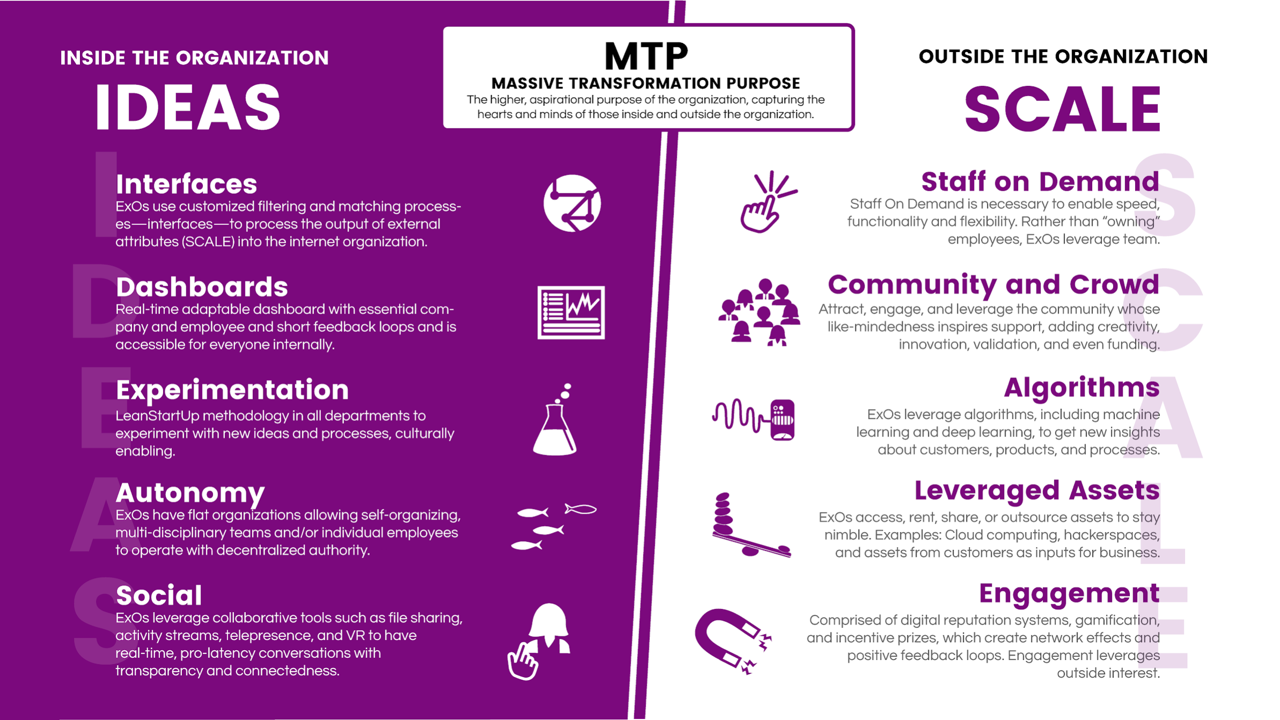
ExO Framework

Integrating ExO Attributes into AI Strategic Roadmap

1. Massive Transformative Purpose (MTP):

Establishing a clear and compelling MTP aligns the organization’s vision with its AI initiatives. For example, a global distributor of commodities might adopt an MTP of “Transforming Global Supply Chains for Sustainability,” guiding all AI efforts towards enhancing efficiency while promoting eco-friendly practices.

2. Algorithms:

Integrating AI algorithms is essential for operational efficiency and decision-making. These algorithms enable real-time data analysis and predictive capabilities. For instance, a logistics company could implement routing algorithms that optimize delivery paths based on traffic data, significantly reducing costs and improving service times.​

3. Data-Driven Customer Analytics (Algorithms):

Utilizing data-driven customer analytics to personalize marketing efforts enhances customer engagement and loyalty. A retail ExO could analyze purchasing patterns to tailor promotions, leading to increased sales and customer satisfaction.

4. Experimentation:

Fostering a culture of experimentation is vital for innovation. By encouraging teams to pilot AI initiatives, organizations can discover effective applications and refine their approaches.

5. Community & Crowd:

Engaging with a community of users and stakeholders drives co-creation and innovation. An ExO might establish platforms for customers to provide feedback on AI-driven solutions, allowing for continuous improvement and adaptation.

6. Staff on Demand:

Leveraging external talent provides flexibility and access to specialized skills. For instance, a company could hire freelance AI experts to develop machine learning models, staying at the forefront of technological advancements without the long-term commitment of full-time hires.

7. Engagement:

Creating engaging experiences through AI-driven interactions enhances customer satisfaction and loyalty. A financial services ExO could implement chatbots powered by large language models to provide personalized customer support, improving response times and user experience.

8. Dashboards:

Implementing real-time dashboards to monitor KPIs related to AI initiatives helps organizations make informed decisions. For example, a manufacturing ExO could track metrics such as production efficiency and downtime in real-time, enabling quick adjustments to operations.

Integrating ExO Attributes into AI Strategic Framework:

Exponential Organization (ExO) that effectively adopts and implements AI initiatives is defined as a forward-thinking entity that harnesses advanced AI technologies—including AI algorithms, machine learning models, large language models, and generative AI—to drive transformative growth and innovation at an unprecedented scale, leveraging low-code platforms and other cloud-based business solutions that already integrate the complexity of the technology for every one adoption. This organization integrates these AI capabilities into its core operations, enabling data-driven decision-making, enhancing customer experiences, and optimizing processes to achieve ten times greater outcomes than traditional organizations.

By integrating ExO principles into the AI strategic framework, organizations can enhance their capacity for rapid innovation, operational efficiency, and significant value creation, ultimately achieving exponential growth.

1. AI Readiness and Strategy:

Embed the MTP into the AI vision and strategy. Develop a roadmap that incorporates ExO principles, emphasizing flexibility, community engagement, and continuous learning.

2. Technology and Data Strategy:

Leverage cloud computing, low-code platforms, AI-as-a-Service, and scalable infrastructure. Ensure data quality and accessibility to support data-driven decision-making and continuous improvement.

3. Organization and Culture:

Foster a culture of experimentation and autonomy. Engage employees through gamification and user-centric design. Promote transparent communication and community involvement.

4. AI Governance:

Implement robust governance frameworks to manage risks, ensure compliance, and maintain trust. Use real-time dashboards to monitor and report on AI governance metrics.

An Exponential Organization effectively adopting AI initiatives enhances its internal capabilities through cutting-edge technologies and redefines its market approach by delivering innovative solutions that meet evolving consumer needs, ultimately achieving exponential growth and impact in a competitive landscape.

Conclusion: 

Successfully navigating AI adoption requires a strategic, multi-faceted approach that integrates technology, culture, governance, and leadership. Mid-market organizations can unlock significant value by aligning AI initiatives with business goals, fostering a culture of innovation, and implementing robust governance frameworks. As you embark on your AI journey, remember that customization and adaptability are key. Embrace the principles of Exponential Organizations to stay ahead of the curve and achieve transformative growth. At Escalate Group, we are here to guide you through every step, ensuring your AI initiatives drive meaningful impact and sustainable success.

Understanding Your Business AI Journey

Understanding Your Business AI Journey

May 9, 2024

Automatización de procesos en la manufactura

Embarking on an AI journey is essential for any modern business, but knowing where to start and how to progress effectively can be daunting. At Escalate Group, we understand that each business’s path toward AI transformation is unique, featuring distinct challenges, milestones, and achievements. We have identified different stages in this journey, and using insights from the “Preparing for AI: Are You Ready for a New Era of Work?” e-book and our AI Studio practice, we’ll provide you with a more precise roadmap and practical tools to assess and enhance your AI readiness.

The Stages of AI in Business:

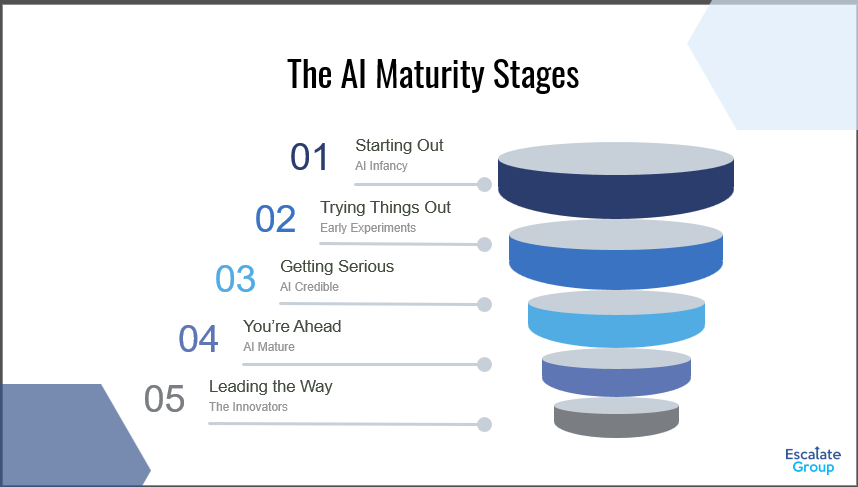
AI maturity steps V2

1. Starting Out (AI Infancy):

If AI is new to your organization, begin by establishing a baseline understanding of what AI can do for you, this will help your organization transition from inertia to initial awareness. Use readiness assessments to evaluate your current technological landscape and organizational culture.

Tip: Start small by automating simple tasks to see immediate benefits while building AI familiarity.

2. Trying Things Out (Early Experiments):

Once you’re aware of AI’s potential, experiment with pilot projects. We suggest using structured assessments to select and prioritize projects that align with your strategic goals and current capabilities.

Tip: Focus on projects with clear ROI to secure early wins and build momentum.

3. Getting Serious (AI Credible):

After experimenting, it’s time to solidify your AI strategy. Use comprehensive planning tools to integrate AI deeper into your business processes and address any technological or cultural barriers.

Tip: Ensure all stakeholders are on board with a shared vision for AI’s role in the business.

4. You’re Ahead (AI Mature):

With successful AI implementations on your corner where you’re already using AI well with your current systems, look to scale your efforts and explore more complex AI applications. We provide advanced techniques for assessing readiness to scale and enhance customer experiences and operational efficiency.

Tip: Regularly review and update your AI strategies to adapt to new technologies and market changes.

5. Leading the Way (The Innovators):

As a leader in AI, continuously seek innovative applications and set industry standards. We want to highlight the importance of maintaining ethical standards, pushing the envelope responsibly, solving new problems, and catching new opportunities.

Tip: Foster a culture of continuous learning and innovation to keep your edge sharp.

How Can the ExQ Survey Help?

ExO Framework

The Exponential Organizations (ExO) Framework

We have found in the ExQ Survey an invaluable tool for assessing an organization’s Exponential Quotient (ExQ). This framework, refined through global expertise, helps us see how ready your business is for AI.

The Exponential Quotient (ExQ) Survey gauges how prepared your business is for AI, examining aspects like scalability, adaptability, and innovation readiness. We’ve integrated the survey with insights from the e-book to offer a detailed analysis that pinpoints your current stage and provides customized advice.

It looks at how your business scales, adapts and uses new ideas. The ExQ survey has helped us provide advice that perfectly fits our customer business and has unlocked personalized strategies for leveraging AI to its maximum potential.

We’ve also combined the survey results with knowledge from our AI practice and the Microsoft AI Cloud Partners Program to deliver a thorough analysis that identifies your stage and offers tailored recommendations.  

Critical AI Readiness Factors: Key Points to Consider

When getting your business ready for AI, there are a few essential things you need to check:

1. Data Readiness:

Think of data as the fuel for your AI. Clean, organized, and accessible data is crucial for AI success. Audit your data quality and structure to ensure it supports your AI goals. This means checking if the data matches your business goals, ensuring it’s safe and high-quality, and seeing if your team can use it well.

Tip: Implement regular data cleaning protocols to maintain data integrity.

2. Organizational Digital Technology Assessment:

This is about making sure your tech is up to speed. Evaluate if your current tech is compatible and ready for AI. We suggest checking your systems’ integration capabilities and identifying needed upgrades.

Tip: Plan for gradual tech enhancements to avoid disruptions and new tools that work better with AI.

3. Ethical Considerations for AI:

Using AI correctly is super important. Ethical AI use builds trust and ensures compliance. This includes making sure AI decisions are straightforward and can be explained, respecting privacy, and using AI for good. We recommend establishing clear guidelines for fairness, transparency, and accountability in AI applications.

Tip: Regularly train your team on ethical AI practices to reinforce their importance.

By focusing on these areas, you can help prepare your business for AI, ensuring that when you adopt AI, it works well, is fair, and helps your business grow correctly.

Conclusion: Discovering Your AI Path

Knowing where you are in your AI journey enables more strategic decisions and tailored implementations. By assessing your current AI stage, you can make the best choices for using AI in your business. With our enhanced guidance and the practical steps outlined, you can confidently navigate your AI integration, ensuring that each phase of your journey is productive and aligned with your business objectives.

Ready to Start?

Join us at Escalate Group to find your place in the AI world and improve your business. Let’s find out what AI can do for you!

How AI Is Transforming Sports and Business

How AI Is Transforming Sports and Business

April 28, 2024

Automatización de procesos en la manufactura

AI is revolutionizing business and sports by enhancing performance, streamlining processes, and uncovering new opportunities. From the U.S. Bank CFO Survey’s focus on AI-driven efficiency to the IOC’s Olympic AI Agenda, this article dives into AI’s transformative role in both arenas. Explore how to adopt AI thoughtfully to drive innovation and maintain integrity.

Introduction: The Intersection of AI, Business, and Sports

At Escalate Group, we have witnessed first-hand the transformative impact of Artificial Intelligence (AI) across various sectors. Whether in the boardrooms of fast-growing companies or the sports fields, AI’s influence is undeniable. Today, we want to explore two pivotal developments that illustrate AI’s expanding role: the recent U.S. Bank CFO Survey and the International Olympic Committee’s (IOC) launch of the Olympic AI Agenda. Both developments provide crucial insights into how AI is being adopted in business and sports, shaping strategies and prompting executives to rethink their approaches.

The Strategic Shift in Business: Insights from the U.S. Bank CFO Survey

The U.S. Bank CFO Survey revealed a compelling shift in how businesses are navigating economic uncertainties with AI. Key findings indicate that while many companies are tightening their belts, there is a clear focus on strategic investments in AI. This pivot is not about substituting human efforts but enhancing efficiencies and uncovering new opportunities.

Cost Control and AI:

In the face of an economic slowdown, businesses are prioritizing cost efficiency. AI emerges as a critical tool in this context, automating processes and reducing operational costs without compromising output quality.

Risk Management:

With rising geopolitical tensions, AI’s role in risk assessment has become more crucial than ever. Advanced analytics and machine learning models are employed to predict market trends and mitigate risks, aiding executives in making more informed decisions.

Investment Priorities:

Despite a general trend of cost-cutting, investment in AI remains high on the agenda. This indicates a strong belief among CFOs that AI is not just a cost center but a vital element for long-term growth.

AI in Sports: Revolutionizing the Game

The IOC’s Olympic AI Agenda sets a groundbreaking precedent for integrating AI in sports. This agenda not only focuses on enhancing athlete performance but also ensures that AI adoption aligns with the core values of fairness and integrity in sports.

Human-Centric AI:

The IOC emphasizes that AI should support, not replace, human athletes. This approach is crucial in maintaining the spirit of competition and ensuring that technology enhances human capabilities rather than overshadowing them.

Governance and Fairness:

A robust governance framework is crucial to oversee AI implementations, ensuring they are fair and equitable across all levels of sport. This includes equal access to AI technologies and safeguarding against biases affecting competition outcomes.

Collaborative Development:

By involving experts from various fields in the development of the AI Agenda, the IOC demonstrates the importance of multi-disciplinary collaboration in harnessing AI’s potential responsibly.

The Convergence of AI in Business and Sports: Lessons for Leaders

Developments in both business and sports offer valuable lessons for leaders at all levels. AI’s role as a transformative agent is clear, but its successful integration requires a thoughtful approach that considers ethical implications, human impact, and long-term sustainability.

Ethical AI Use:

The ethical use of AI is paramount, whether in business operations or sports management. Leaders must ensure that AI systems are designed and implemented to uphold ethical standards and contribute positively to society.

Long-term Sustainability:

Investments in AI should be viewed through the lens of long-term sustainability. In business, this means using AI to build systems that are not only efficient but also adaptable to future challenges. In sports, it means leveraging AI to enhance the experience and integrity of the game without compromising its values.

Preparing for a Future Shaped by AI

As we look to the future, the integration of AI into both business strategies and sports management will undoubtedly continue to grow. For us as leaders, the task is not just to adopt AI but to do so in a way that is thoughtful, ethical, and aligned with our long-term visions.

Continuous Learning and Adaptation:

The landscape of AI is ever-evolving. Continuous learning and adaptation are necessary to keep pace with technological advancements and their applications in our fields.

Collaboration Across Sectors:

AI presents challenges and opportunities that cannot be tackled in isolation. Collaborative efforts across sectors and disciplines will be essential in realizing AI’s full potential.

Conclusion: Leading with Insight and Integrity

In conclusion, the insights from the U.S. Bank CFO Survey and the IOC’s Olympic AI Agenda provide us with a blueprint for how AI can be integrated thoughtfully into our operations and strategies. As we continue to explore AI’s vast potential, let us commit to leading with insight and integrity, ensuring that our endeavors not only drive growth but also foster a positive impact in our communities and industries. The journey with AI is just beginning, and together, we can shape a future that reflects our highest aspirations and values.