
Empowering People with AI: How Workshops Unlock Confidence and Innovation

Empowering People with AI: How Workshops Unlock Confidence and Innovation

Septiembre 30, 2025

By Olga Calvache
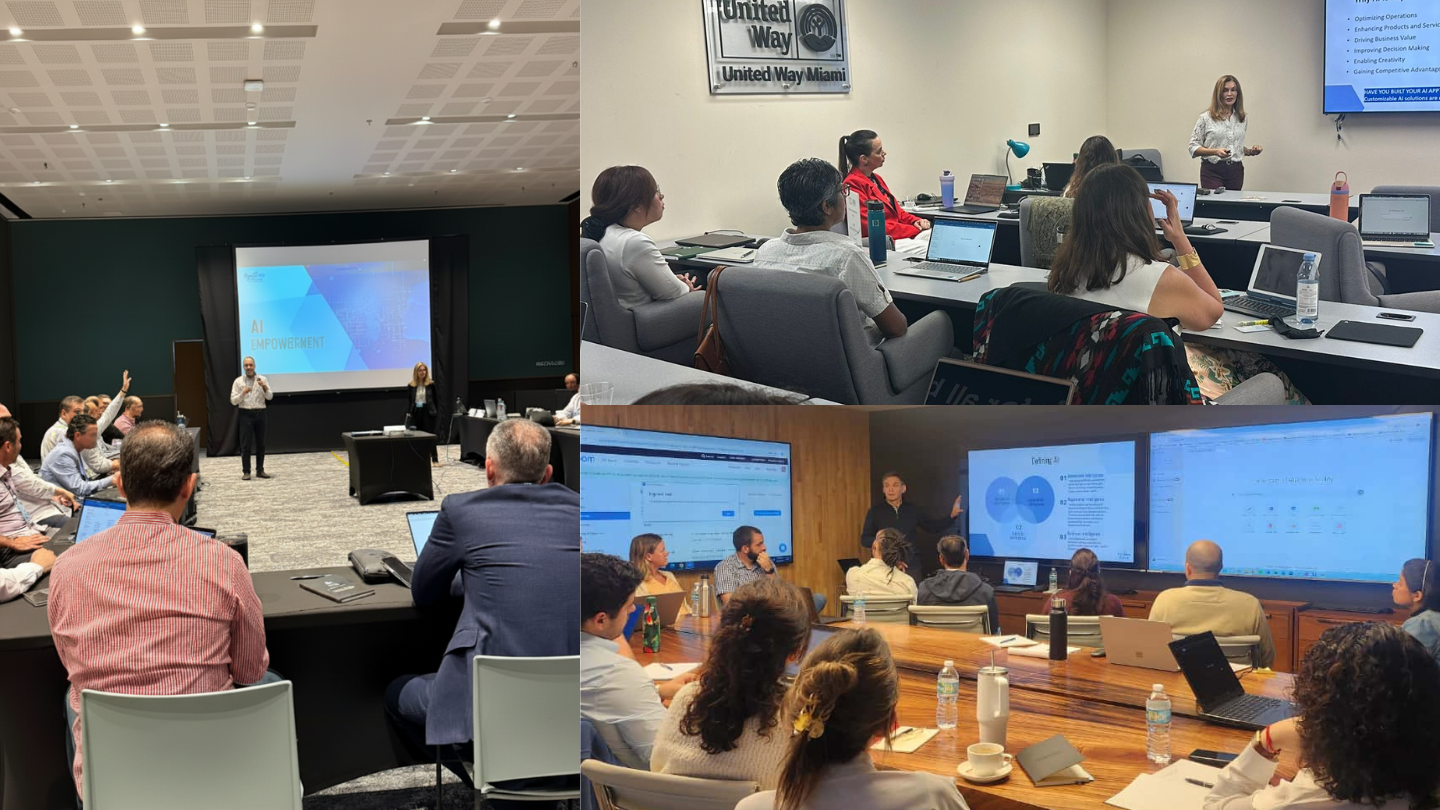
Escalate Group, AI Workshops

AI upskilling is no longer optional, it’s essential. Discover lessons from Escalate Group’s workshops on how leaders can empower teams, foster collaboration, and build AI confidence for the future of work. 

Introduction: 

At Escalate Group, we’re building on the experience we’ve gained guiding organizations in innovation and exponential thinking since 2017.

For more than two years, I’ve been leading AI Empowerment Workshops for executives and teams across industries such as healthcare, finance, retail, and manufacturing.

These sessions have never been about showcasing the latest tools. They’ve been about helping people rethink the way they work, building confidence, sparking curiosity, and showing what’s possible when AI becomes a trusted ally in daily routines.

And one thing is clear: AI upskilling is no longer optional, it’s essential

Why AI Upskilling Matters Now

AI is transforming the nature of work at an unprecedented pace. Leaders everywhere are asking: How do we prepare our teams for this new reality?

The challenge isn’t just technological. It’s cultural. Resistance often comes from habits, fears of making mistakes, or simply not having the time to explore new tools. That’s why our approach puts mindset before technology.

When people see how AI can handle repetitive tasks — from summarizing reports to generating client-ready presentations — they don’t just save time. They start asking better questions, and they begin to imagine how their work could be redefined.

More on the topic: Reskilling in the age of AI from Harvard Business Review

What We’ve Learned from Our Workshops

Through more than a dozen AI upskilling sessions, three things have consistently worked:

Start with motivation. People adopt AI when they understand the “why” and see personal benefits.

Make it real. Using client-specific data makes the impact tangible and the “aha” moments immediate.

Encourage collaboration. Small-group exercises not only build skills but also foster a stronger team culture.

The results speak for themselves:

– 90% of participants reported they could save five or more hours per week using AI after the workshop.

– One client automated three recurring tasks within 48 hours, freeing their team for more strategic work.

Most importantly, participants walk away excited to continue experimenting and to share what they’ve learned with colleagues. This creates momentum and a ripple effect across the organization.

How to Start in Your Organization

If you’re a leader wondering how to begin, here are three principles we’ve seen make the difference:

Set the right mindset. Make it safe to experiment. Remind teams that “done is better than perfect.”

Look at workflows with fresh eyes. Ask: What can I make easier today so I can focus on higher-value work tomorrow?

Invest in small wins. Big transformations start with small successes that prove the value and build confidence.

The Future of Work with AI

The organizations that thrive won’t just be AI-literate, they’ll be AI-confident. They’ll empower every employee to build their own team of digital assistants, amplifying human potential rather than replacing it.

This is more than upskilling. It’s a cultural shift toward continuous learning, collaboration, and innovation. And it’s already happening.

Check our Innovation Sprints

Conclusion: A final reflection

At Escalate Group, our purpose is to help companies unlock digital value. Through our workshops, advisory services, and innovation sprints, we guide leaders and teams to embrace AI not as a challenge, but as an opportunity for growth.

My advice to leaders is simple: start small, start now, and start with your people. Because once your team experiences what’s possible, there’s no going back.

How the GENIUS Act 2025 and Stablecoins Are Reshaping Enterprise Finance

How the GENIUS Act 2025 and Stablecoins Are Reshaping Enterprise Finance

September 15, 2025

Smartphone showing programmable finance and digital dollar icons over a city skyline, representing stablecoins and GENIUS Act 2025 impact on enterprise finance.

The GENIUS Act 2025 marks a turning point in digital finance. Stablecoins are now programmable, compliant dollars unlocking real-time treasury, payments, and global operations. Here’s what business leaders need to know.

Introduction:  

The financial system is experiencing a foundational shift. With the enactment of the GENIUS Act 2025, stablecoins once associated mainly with crypto speculation—are now recognized as compliant, programmable digital dollars designed to operate within the fabric of enterprise finance.

This transformation is not a tech trend; it is a restructuring of financial infrastructure. And the question for today’s business leaders is no longer if stablecoins will matter, but how to seize their strategic advantage.

The GENIUS Act: Policy Meets Possibility

The Guiding and Establishing National Innovation for U.S. Stablecoins (GENIUS) Act 2025 offers the first comprehensive federal framework for U.S. dollar-backed stablecoins. It mandates 1:1 reserve backing in cash or U.S. Treasuries, oversight by licensed issuers, and strict audit standards.

More significantly for the enterprise, the law affirms that compliant stablecoins are not bank deposits or securities and can be used as regulated financial instruments for payments and treasury.

According to Coindesk, the GENIUS Act is projected to drive a $25 to $75 billion surge in stablecoin supply, unlocking adoption by corporates, financial institutions, and governments alike.

This shift supports the vision outlined in Escalate Group’s  where Web3 Digital Capital Innovation Studio,programmable liquidity becomes a foundation for business agility and financial innovation

Where Opportunity Meets Urgency

Regulatory clarity is catalyzing institutional momentum. Stablecoin transaction volume surpassed $27 trillion in 2024, exceeding the combined total of Visa and Mastercard. Analysts from Bloomberg, ARK, and Citi expect the stablecoin market to reach $2–3.7 trillion by 2030.

As Reuters reports, the U.S. Treasury anticipates that stablecoins could become one of the largest holders of government debt by 2028, with projected reserve demand approaching $2 trillion.

A 2025 report by Fireblocks found that 90% of institutions are already building stablecoin infrastructure, with over 70% of enterprises in Latin America using or piloting stablecoin payments.

Strategic Use Cases by Industry

Retail 

Retailers are moving toward programmable loyalty systems and faster global payouts.

  • USDC is being used to pay international suppliers and creators in real time
  • Cashback and loyalty programs are being replaced by closed-loop digital dollars.
  • Smart payments are being triggered by inventory and order data

Telecom 

Telecoms are emerging as natural pioneers of stablecoins thanks to their infrastructure and global footprint.

  • Cross-border roaming and wholesale settlements are happening in stablecoins.
  • Prepaid customers gain real-time top-ups and micro-remittances
  • Zeebu and other Web3-native telco platforms are already live in LATAM and MENA

This aligns with Escalate Group’s Telecom + Stablecoin strategy briefing that explores wallet integration, AI risk scoring, and programmable identity layers.

Manufacturing 

Manufacturers are streamlining liquidity across global supply chains.

  • Treasury teams are adopting stablecoins for intercompany transfers
  • Tokenized trade finance enables faster access to working capital
  • Smart contracts are automating invoice validation and supplier payments

Healthcare and Fintech 

  • Health platforms are testing real-time insurance disbursements
  • Fintechs are using programmable dollars for gig economy payouts, rewards, and embedded finance
  • Identity-linked stablecoins are powering compliance and tax reporting

Why This Matters Now for the C-Suite

For CFOs, stablecoins unlock real-time liquidity, cross-border cash movement, and yield optimization through tokenized Treasuries. For COOs, they enable automation of settlement, compliance, and treasury execution.

For CEOs and innovation leaders, programmable money enables new digital services, from customer rewards to machine-to-machine commerce.

By combining programmable money with AI insights, leaders can move from reactive finance to predictive intelligence, as outlined in Escalate Group’s AI Transformation programs.

These are not speculative gains. They are measurable ROI outcomes: faster payments, reduced fees, decreased float, and improved visibility.

Escalate Group’s Role: From Readiness to Execution

Escalate Group works with executive teams to move from insight to impact. Our offering includes:

  • Stablecoin Readiness Briefings to identify near-term opportunities
  • Strategic Sprints to design and validate enterprise pilots
  • Execution Support to ensure compliance, integration, and scalability

We are actively engaging with infrastructure leaders to provide our clients access to secure, regulatory-ready stablecoin systems that deliver operational and financial value.

Conclusion: What Comes Next, Leadership in a Tokenized Economy

GENIUS Act 2025 is not just policy. It is a financial infrastructure signal. The organizations that act now, testing pilots, building workflows, upgrading treasury will shape tomorrow’s standards.

Executives are already assembling internal teams. Boards are exploring how tokenized liquidity can drive returns. Digital capital strategy is moving from R&D into operations.

This is the beginning of a broader transformation, where money moves at the speed of logic, not bureaucracy.

To learn how your company can explore this transformation with strategic clarity, connect with us at Escalate Group or request a Stablecoin Readiness Briefing.

The infrastructure is ready. The regulation is here. The leadership opportunity is yours.

“Let us help you make programmable finance real for your business.”